Kingdom of Italy
7 events
The Kingdom of Italy was a unitary state that existed from 17 March 1861, when Victor Emmanuel II, King of Sardinia, was proclaimed King of Italy, until 18 June 1946, when the monarchy was abolished, following civil discontent that led to an institutional referendum on 2 June, resulting in the establishment of the modern Italian Republic. The kingdom was established through the unification of several states over a decades-long process, called the Risorgimento. That process was influenced by House of Savoy-ruled Sardinia, which was one of Italy's legal predecessor states.
Text from the Wikipedia article Kingdom of Italy, CC BY-SA 4.0
Built from Wikidata: an event or person is listed when Wikidata links them to this page, as shown next to each one. Many aren’t recorded there, so this list is incomplete.
Countries on this land today
Key people
 Benito Mussolini1883 – 1945Dictator of Italy from 1922 to 1945Source: Wikidata (citizenship)
 Giuseppe Verdi1813 – 1901Italian opera composer (1813–1901)Source: Wikidata (citizenship)
 Enrico Fermi1901 – 1954Italian–American physicist (1901–1954)Source: Wikidata (citizenship)
 Umberto Eco1932 – 2016Italian semiotician, essayist, philosopher, literary critic, and novelist (1932–2016)Source: Wikidata (citizenship)
 Giacomo Puccini1858 – 1924Italian opera composer (1858–1924)Source: Wikidata (citizenship)
 Luigi Pirandello1867 – 1936Italian dramatist, novelist, short story writer and poet (1867-1936)Source: Wikidata (citizenship)
 Giuseppe Garibaldi1807 – 1882Italian general, patriot and republican (1807–1882)Source: Wikidata (citizenship)
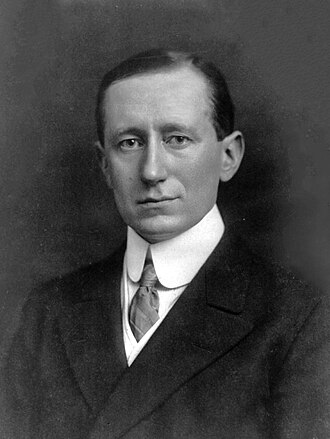 Guglielmo Marconi1874 – 1937Italian inventor and radio pioneer (1874–1937)Source: Wikidata (citizenship)
 John Paul I1912 – 1978Pope of the Catholic Church in 1978Source: Wikidata (citizenship)
 Antonio Gramsci1891 – 1937Italian Marxist philosopher, writer, and politician (1891–1937)Source: Wikidata (citizenship)
 Paul VI1897 – 1978Pope of the Catholic Church from 1963 to 1978 (1897–1978)Source: Wikidata (citizenship)
 Giosuè Carducci1835 – 1907Italian poet and literary critic (1835–1907)Source: Wikidata (citizenship)
 Grazia Deledda1871 – 1936Italian novelist (1871-1936)Source: Wikidata (citizenship)
 Luciano Pavarotti1935 – 2007Italian operatic tenor (1935–2006)Source: Wikidata (citizenship)
 Leo XIII1810 – 1903Pope of the Catholic Church from 1878 to 1903 (1810–1903)Source: Wikidata (citizenship)
 Gabriele D'Annunzio1863 – 1938Italian writer, poet, playwright, soldier and politician (1863-1938)Source: Wikidata (citizenship)
 Pius IX1792 – 1878Pope of the Catholic Church from 1846 to 1878Source: Wikidata (citizenship)
 Dario Fo1926 – 2016Italian actor, playwright, comedian, singer-songwriter, theater director, painter, and political activist (1926-2016)Source: Wikidata (citizenship)
 Alessandro Manzoni1785 – 1873Italian writer and poet (1785–1873)Source: Wikidata (citizenship)
 Maria Montessori1870 – 1952Italian physician and educator (1870-1952)Source: Wikidata (citizenship)
 Gioachino Rossini1792 – 1868Italian opera composer (1792–1868)Source: Wikidata (citizenship)
 Rita Levi-Montalcini1909 – 2012Italian neurologist (1909–2012)Source: Wikidata (citizenship)
 Giuseppe Mazzini1805 – 1872Italian nationalist activist, politician, journalist and philosopherSource: Wikidata (citizenship)
 Marcello Mastroianni1924 – 1996Italian actor (1924–1996)Source: Wikidata (citizenship)
 Pier Paolo Pasolini1922 – 1975Italian writer, filmmaker, poet, and intellectual (1922–1975)Source: Wikidata (citizenship)
 Salvatore Quasimodo1901 – 1968Italian writer (1901-1968)Source: Wikidata (citizenship)
 Camillo Benso di Cavour1810 – 1861First Prime Minister of the Kingdom of Italy from March to June in 1861Source: Wikidata (citizenship)
 Eugenio Montale1896 – 1981Italian poet (1896-1981)Source: Wikidata (citizenship)
 Primo Levi1919 – 1987Italian chemist, partisan, Holocaust survivor, and writer (1919–1987)Source: Wikidata (citizenship)
 Aldo Moro1916 – 1978Italian politician (1916-1978)Source: Wikidata (citizenship)
 Alberto Moravia1907 – 1990Italian writer and journalist (1907-1990)Source: Wikidata (citizenship)
 Italo Calvino1923 – 1985Italian journalist and writer (1923-1985)Source: Wikidata (citizenship)
 Amedeo Modigliani1884 – 1920Italian painter and sculptor (1884–1920)Source: Wikidata (citizenship)
 Carlo Collodi1826 – 1890Italian writer (1826–1890)Source: Wikidata (citizenship)
 Giulio Andreotti1919 – 2013Italian politician and statesman (1919–2013)Source: Wikidata (citizenship)
 Francesco Cossiga1928 – 20108th President of Italy (1928-2010)Source: Wikidata (citizenship)
 Bernardo Bertolucci1941 – 2018Italian film director and screenwriter (1941–2018)Source: Wikidata (citizenship)
 Vilfredo Pareto1848 – 1923Italian economist and sociologist (1848-1923)Source: Wikidata (citizenship)
 Benedetto Croce1866 – 1952Italian philosopher (1866-1952)Source: Wikidata (citizenship)
 Frank Capra1897 – 1991Italian-born American film director (1897–1991)Source: Wikidata (citizenship)
 Vittorio De Sica1901 – 1974Italian film director (1901-1974)Source: Wikidata (citizenship)
 Victor Emmanuel II of Italy1820 – 1878King of Sardinia (1849–1861) and King of Italy (1861–1878)Source: Wikidata (citizenship)
 Camillo Golgi1843 – 1926Italian physician, pathologist, scientist, and Nobel laureate (1843-1926)Source: Wikidata (citizenship)
 Riccardo Giacconi1931 – 2018Italian-American astrophysicist (1931-2018)Source: Wikidata (citizenship)
 Cesare Pavese1908 – 1950Italian writer, literary critic, and translator (1908–1950)Source: Wikidata (citizenship)
 Michelangelo Antonioni1912 – 2007Italian film director and screenwriter (1912–2007)Source: Wikidata (citizenship)
 Carlo Azeglio Ciampi1920 – 2016President of Italy from 1999 to 2006Source: Wikidata (citizenship)
 Emilio G. Segrè1905 – 1989Italian physicist and Nobel laureateSource: Wikidata (citizenship)
Showing the 48 best-known of 124 people.
Everything that happened
- 19081908 Messina earthquakeItalyA devastating earthquake occurred on 28 December 1908 in Sicily and Calabria, southern Italy, with a moment magnitude of 7.1 and a maximum Mercalli intensity of XI (Extreme). The epicentre was in the Strait of Messina which separates Sicily from the Italian mainland.Source: Wikidata (country)
- 1920Treaty of RapalloRapalloThe Treaty of Rapallo was an agreement between the Kingdom of Italy and the Kingdom of Serbs, Croats and Slovenes in the aftermath of the First World War. It was intended to settle the Adriatic question, which referred to Italian claims over territories promised to the country in return for its entry into the war against Austria-Hungary, claims that were made on the basis of the 1915 Treaty of London.Source: Wikidata (country)
- 1922March on RomeRomeThe March on Rome (Italian: Marcia su Roma) was an organized mass demonstration in October 1922 which resulted in Benito Mussolini's National Fascist Party (Partito Nazionale Fascista, PNF) ascending to power in the Kingdom of Italy.Source: Wikidata (country)
- 1930London Naval TreatyLondonThe London Naval Treaty, officially the Treaty for the Limitation and Reduction of Naval Armament, was an agreement between the United Kingdom, Japan, France, Italy, and the United States that was signed on 22 April 1930.Source: Wikidata (country)
- 1943Fall of the Fascist regime in ItalyKingdom of ItalyThe fall of the Fascist regime in Italy, also known in Italy as 25 Luglio (Italian: Venticinque Luglio, pronounced [ˌventiˈtʃiŋkwe ˈluʎʎo]; lit. '25 July'), came as a result of parallel plots led respectively by Dino Grandi and King Victor Emmanuel III during the spring and summer of 1943, culminating with a successful vote of no confidence against Prime Minister Benito Mussolini at the meeting of the Grand Council…Source: Wikidata (country)
- 1943Foibe massacresJulian MarchThe foibe massacres (Italian: massacri delle foibe; Slovene: poboji v fojbah; Croatian: masakri fojbe), or simply the foibe, refers to ethnic cleansing, mass killings and deportations during and immediately after World War II, mainly committed by Yugoslav Partisans and OZNA in the then-Italian territories of Julian March (Karst Region and Istria), Kvarner and Dalmatia, primarily against local Italians (Istrian…Source: Wikidata (country)
- 1943George S. Patton slapping incidentsUnited StatesIn early August 1943, Lieutenant General George S. Patton slapped two United States Army soldiers under his command during the Allied invasion of Sicily of World War II. Patton's hard-driving personality and lack of belief in the medical condition of combat stress reaction, then known as "battle fatigue" or "shell shock," led to the soldiers' becoming the subject of his ire in incidents on August 3 and 10, when…Source: Wikidata (country)