Soviet Union
35 events
The Soviet Union, officially the Union of Soviet Socialist Republics (USSR), was a transcontinental country that spanned much of Eurasia from its formation in 1922 until its dissolution in 1991. It was the world's third-most populous country, the largest by area, and bordered twelve other countries. A diverse multinational state, it was organized as a federal union of national republics, with the largest and most populous being the Russian Soviet Federative Socialist Republic (SFSR).
Text from the Wikipedia article Soviet Union, CC BY-SA 4.0
Built from Wikidata: an event or person is listed when Wikidata links them to this page, as shown next to each one. Many aren’t recorded there, so this list is incomplete.
Countries on this land today
Key people
 Vladimir Putinb. 1952President of the Russian FederationSource: Wikidata (citizenship)
 Vladimir Lenin1870 – 1924Founding leader of the Soviet Union (1870–1924)Source: Wikidata (citizenship)
 Joseph Stalin1878 – 1953Politician and leader of the Union of Soviet Socialist Republics from 1924 to 1953Source: Wikidata (citizenship)
 Volodymyr Zelenskyyb. 1978President of Ukraine since 2019Source: Wikidata (citizenship)
 Yuri Gagarin1934 – 1968Soviet pilot and cosmonaut, first human in space (1934–1968)Source: Wikidata (citizenship)
 Mikhail Gorbachev1931 – 2022Leader of the Soviet Union from 1985 to 1991 (1931–2022)Source: Wikidata (citizenship)
 Leon Trotsky1879 – 1940Russian Marxist revolutionary (1879–1940)Source: Wikidata (citizenship)
 Maxim Gorky1868 – 1936Russian and Soviet writer (1868–1936)Source: Wikidata (citizenship)
 Dmitry Medvedevb. 1965President of Russia from 2008 to 2012, Prime Minister of Russia (2012-2020) and Deputy Chairman of the Security Council of Russia since 2020Source: Wikidata (citizenship)
 Nikita Khrushchev1894 – 1971Leader of the Soviet Union from 1953 to 1964Source: Wikidata (citizenship)
 Anna Netrebkob. 1971Russian and Austrian operatic sopranoSource: Wikidata (citizenship)
 Boris Yeltsin1931 – 2007Soviet and Russian politician, 1st President of Russia (1931–2007)Source: Wikidata (citizenship)
 Kim Il-sung1912 – 1994Supreme Leader of North Korea from 1948 to 1994Source: Wikidata (citizenship)
 Aleksandr Solzhenitsyn1918 – 2008Russian writer, publicist, poet and politician (1918–2008)Source: Wikidata (citizenship)
 Alexander Lukashenkab. 1954President of the Republic of BelarusSource: Wikidata (citizenship)
 Sergei Eisenstein1898 – 1948Soviet filmmaker (1898–1948)Source: Wikidata (citizenship)
 Boris Pasternak1890 – 1960Russian writer (1890–1960)Source: Wikidata (citizenship)
 Leonid Brezhnev1906 – 1982General Secretary of the Communist Party of the Soviet Union (1906–1982)Source: Wikidata (citizenship)
 Alexei Navalny1976 – 2024Russian jurist and opposition leader (1976-2024)Source: Wikidata (citizenship)
 Valentina Tereshkovab. 1937Russian cosmonaut and pilot, first woman to have flown in space (born 1937)Source: Wikidata (citizenship)
 Anna Akhmatova1889 – 1966Russian poet (1889–1966)Source: Wikidata (citizenship)
 Ilham Aliyevb. 1961President of Azerbaijan since 2003Source: Wikidata (citizenship)
 Valery Leontievb. 1949Russian singerSource: Wikidata (citizenship)
 Ayn Rand1905 – 1982Russian-born American writer and public philosopher (1905–1982)Source: Wikidata (citizenship)
 Joseph Brodsky1940 – 1996Russian-American poet, essayist, and Nobel laureate (1940–1996)Source: Wikidata (citizenship)
 Vladimir Mayakovsky1893 – 1930Russian and Soviet poet (1893–1930)Source: Wikidata (citizenship)
 Ivan Pavlov1849 – 1936Russian physiologist (1849–1936)Source: Wikidata (citizenship)
- Svetlana Alexievichb. 1948Belarusian investigative journalist and non-fiction prose writer (born 1948)Source: Wikidata (citizenship)
 Petro Poroshenkob. 1965President of Ukraine from 2014 to 2019Source: Wikidata (citizenship)
 Mikheil Saakashvilib. 1967Georgian and Ukrainian politician, third President of Georgia (2004–2013) and Governor of Odesa Oblast (2015–2016)Source: Wikidata (citizenship)
 Mila Kunisb. 1983American actress (born 1983)Source: Wikidata (citizenship)
 Garry Kasparovb. 1963Russian chess grandmaster and activistSource: Wikidata (citizenship)
 Viktor Yanukovychb. 1950President of Ukraine from 2010 to 2014Source: Wikidata (citizenship)
 Mikhail Bulgakov1891 – 1940Russian author (1891–1940)Source: Wikidata (citizenship)
 Mikhail Sholokhov1905 – 1984Soviet writer (1905-1984)Source: Wikidata (citizenship)
 Vladimir Vysotsky1938 – 1980Soviet singer-songwriter and actor (1938–1980)Source: Wikidata (citizenship)
 Yuri Andropov1914 – 1984General Secretary of the Communist Party of the Soviet Union (1914–1984)Source: Wikidata (citizenship)
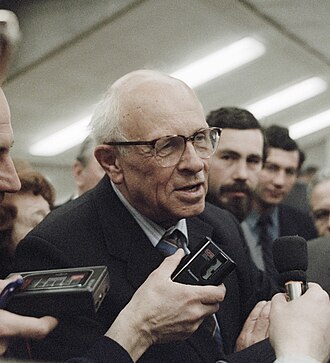 Andrei Sakharov1921 – 1989Soviet nuclear physicist and human rights activist (1921–1989)Source: Wikidata (citizenship)
 Maria Sharapovab. 1987Russian tennis playerSource: Wikidata (citizenship)
 Yulia Tymoshenkob. 1960Ukrainian politician, former Prime MinisterSource: Wikidata (citizenship)
 Nursultan Nazarbayevb. 1940President of Kazakhstan from 1991 to 2019Source: Wikidata (citizenship)
 Sergei Yesenin1895 – 1925Russian poet (1895–1925)Source: Wikidata (citizenship)
 Clara Zetkin1857 – 1933Communist activist, and advocate for women's rights (1857–1933)Source: Wikidata (citizenship)
 Alla Pugachevab. 1949Soviet-Russian singer, composer, and actressSource: Wikidata (citizenship)
 Georgy Zhukov1896 – 1974Marshal of the Soviet Union (1896-1974)Source: Wikidata (citizenship)
 Isadora Duncana1877 – 1927American dancer and choreographer (1877–1927)Source: Wikidata (citizenship)
 Viktor Yushchenkob. 19543rd President of UkraineSource: Wikidata (citizenship)
 Dmitri Shostakovich1906 – 1975Soviet composer and pianist (1906-1975)Source: Wikidata (citizenship)
Showing the 48 best-known of 200 people.
Everything that happened
- 1917 – 1922Russian Civil WarRussian RepublicThe Russian Civil War was a multi-party civil war in the former Russian Empire, lasting from 1917 to 1922, sparked by the overthrowing of the Russian Provisional Government in the October Revolution, as many factions vied to determine Russia's political future. It resulted in the formation of the Russian Socialist Federative Soviet Republic and later the Soviet Union in most of its territory.Source: Wikidata (country)
- 19201920 Ganja revoltGanjaThe 1920 Ganja revolt (Azerbaijani: Gəncə üsyanı) was a popular uprising against the Soviet occupation that took place in Ganja on 26 to 31 May 1920. The goal of the uprising was to overthrow the Soviet government in Azerbaijan. This was the largest rebellion against Soviet rule in Azerbaijan in the 20th century, and caused the most losses.Source: Wikidata (country)
- 1922 – 1991Treaty on the Creation of the Union of Soviet Socialist RepublicsMoscowThe Declaration and Treaty on the Formation of the Union of Soviet Socialist Republics (Russian: Декларация и договор об образовании Союза Советских Социалистических Республик) officially created the Union of Soviet Socialist Republics (USSR), commonly known as the Soviet Union.Source: Wikidata (country)
- 1924August UprisingGeorgian SSRThe August Uprising (Georgian: აგვისტოს აჯანყება, romanized: agvist'os ajanq'eba) was an unsuccessful insurrection against Soviet rule in the Georgian Soviet Socialist Republic from late August to early September 1924.Source: Wikidata (country)
- 1938Battle of Lake KhasanLake KhasanThe Battle of Lake Khasan (Russian: Хасанские бои), also known as the Changkufeng Incident (Chinese and Japanese: 張鼓峰事件; Chinese pinyin: Zhānggǔfēng Shìjiàn; Japanese romaji: Chōkohō Jiken), was an attempted military incursion by Manchukuo, a Japanese puppet state, into territory claimed and controlled by the Soviet Union.Source: Wikidata (country)
- 1939 – 1940Winter WarFinlandThe Winter War was a war between the Soviet Union and Finland. It began with a Soviet invasion of Finland on 30 November 1939, three months after the outbreak of World War II, and ended three and a half months later with the Moscow Peace Treaty on 13 March 1940. Despite superior military strength, especially in tanks and aircraft, the Soviet Union suffered severe losses and initially made little headway.Source: Wikidata (country)
- 1940Katyn massacreKatynThe Katyn massacre was a series of mass executions of Poles carried out by the Soviet Union between April and May 1940. Though the killings also occurred in the NKVD prisons in Kalinin, Kharkiv and elsewhere, the massacre is named after the Katyn forest, where some of the mass graves were first discovered by Nazi German forces in 1943.Source: Wikidata (country)
- 1941 – 1945Eastern FrontSoviet UnionThe Eastern Front, also known as the Great Patriotic War, or the German–Soviet War, was a theatre of World War II fought between the European Axis powers and Allies, including the Soviet Union (USSR) and Poland. It encompassed Central Europe, Eastern Europe, Northeast Europe (Baltics), and Southeast Europe (Balkans), and lasted from 22 June 1941 to 9 May 1945.Source: Wikidata (country)
- 1941Operation BarbarossaEstoniaOperation Barbarossa was the invasion of the Soviet Union by Nazi Germany and several of its European Axis allies starting on Sunday, 22 June 1941, during World War II. More than 3.8 million Axis troops invaded the western Soviet Union along a 2,900-kilometer (1,800 mi) front, with the main goal of capturing territory up to a line between Arkhangelsk and Astrakhan, known as the A–A line.Source: Wikidata (country of the location)
- 1941 – 1942Battle of MoscowMoscow OblastThe Battle of Moscow was a military campaign that consisted of two periods of strategically significant fighting on a 600 km (370 mi) sector of the Eastern Front during World War II, between October 1941 and January 1942. The Soviet defensive effort thwarted Germany's attack on Moscow, the capital and largest city of the Soviet Union.Source: Wikidata (country)
- 1941 – 1944Siege of LeningradSaint PetersburgThe Siege of Leningrad was a military blockade undertaken by the Axis powers against the city of Leningrad (present-day Saint Petersburg) in the Soviet Union on the Eastern Front of World War II from 1941 to 1944. Leningrad, the country's second largest city, was besieged by Germany and Finland for 872 days, but never captured.Source: Wikidata (country)
- 1941Battle of SmolenskSmolenskThe first Battle of Smolensk (German: Kesselschlacht bei Smolensk, lit. 'Cauldron-battle at Smolensk') was a battle during the second phase of Operation Barbarossa, the Axis invasion of the Soviet Union, in World War II. It was fought around the city of Smolensk between 10 July and 10 September 1941, about 400 km (250 mi) west of Moscow.Source: Wikidata (country)
- 1941Medvedev Forest massacreSoviet UnionThe Medvedev Forest massacre (Russian: Медведевский расстрел) or Orel massacre (Орловский расстрел) was a mass execution in the Soviet Union carried out by the Soviet secret police NKVD on 11 September 1941.Source: Wikidata (country)
- 1941NKVD prisoner massacresSoviet UnionThe NKVD prisoner massacres were a series of mass executions of political prisoners carried out by the NKVD, the People's Commissariat for Internal Affairs of the Soviet Union, across Eastern Europe, primarily in Poland, Ukraine, Belarus, the Baltic states, and Bessarabia.Source: Wikidata (country)
- 1941 – 1944Oranienbaum BridgeheadLomonosovThe Oranienbaum Bridgehead (Ораниенбаумский плацдарм in Russian) was an isolated portion of the Leningrad Oblast in Russia, which was retained under Soviet control during the siege of Leningrad in World War II. It played a significant role in protecting the city.Source: Wikidata (country)
- 1943Battle of KurskKurskThe Battle of Kursk, also called the Battle of the Kursk Salient, was a major World War II Eastern Front battle between the forces of Nazi Germany and the Soviet Union near Kursk in southwestern Russia during the summer of 1943, resulting in a Soviet victory. The Battle of Kursk is the single largest battle in the history of warfare.Source: Wikidata (country)
- 1943Kerch–Eltigen operationKerch PeninsulaThe Kerch–Eltigen operation was a World War II amphibious offensive made in November 1943 by the Red Army as a precursor to the Crimean offensive (8 April-12 May 1944), with the object of defeating and forcing the withdrawal of the German forces from the Crimea.Source: Wikidata (country)
- 1943Ostrogozhsk–Rossosh offensiveOstrogozhskThe Ostrogozhsk–Rossosh offensive (Russian: Острогожско-Россошанская операция) was an offensive of the Voronezh Front on the Eastern Front of World War II against the Hungarian 2nd Army and parts of the Italian 8th Army as part of the Voronezh–Kharkov offensive.Source: Wikidata (country)
- 1944Crimean offensiveCrimeaThe Crimean offensive (8 April – 12 May 1944), known in German sources as the Battle of the Crimea, was a series of offensives by the Red Army directed at the German-held Crimea. The Red Army's 4th Ukrainian Front engaged the German 17th Army of Army Group South Ukraine, which consisted of Wehrmacht and Romanian formations. The battles ended with the evacuation of Crimea by the Germans.Source: Wikidata (country)
- 1944Leningrad–Novgorod offensiveSoviet UnionThe Leningrad–Novgorod strategic offensive was a strategic offensive during World War II. It was launched by the Red Army on 14 January 1944 with an attack on the German Army Group North by the Soviet Volkhov and Leningrad fronts, along with part of the 2nd Baltic Front, with a goal of fully lifting the siege of Leningrad.Source: Wikidata (country)
- 1944Minsk offensiveByelorussian Soviet Socialist RepublicThe Minsk offensive (Russian: Минская наступательная операция) was part of the second phase of the Belorussian strategic offensive of the Red Army in summer 1944, commonly known as Operation Bagration.Source: Wikidata (country)
- 1944Petsamo–Kirkenes offensiveArcticThe Petsamo–Kirkenes offensive was a major military offensive during World War II, mounted by the Red Army against the Wehrmacht in 1944 in the Petsamo region, ceded to the Soviet Union by Finland in accordance with the Moscow Armistice, and Norway. The offensive defeated the Wehrmacht's forces in the Arctic, driving them back into Norway, and was called the "Tenth Shock" by Stalin.Source: Wikidata (country)
- 1944Second Jassy–Kishinev offensiveMoldaviaThe Jassy–Kishinev offensive, named after the two major cities, Jassy and Kishinev, in the staging area, was a Soviet offensive against Axis forces, which took place in Eastern Romania from 20 to 29 August 1944 during World War II.Source: Wikidata (country)
- 1944Vyborg–Petrozavodsk offensiveKarelo-Finnish Soviet Socialist RepublicThe Vyborg–Petrozavodsk offensive or Karelian offensive was a strategic operation by the Soviet Leningrad and Karelian Fronts against Finland on the Karelian Isthmus and East Karelia fronts of the Continuation War, on the Eastern Front of World War II. The Soviet forces captured East Karelia and Vyborg/Viipuri. After that, however, the fighting reached a stalemate.Source: Wikidata (country of the location)
- 1960Nedelin catastropheBaikonur CosmodromeThe Nedelin catastrophe or Nedelin disaster, known in Russia as the Catastrophe at Baikonur Cosmodrome (Russian: Катастрофа на Байконуре, romanized: Katastrofa na Baikonure), was a launch-pad accident that occurred on 24 October 1960 at the Baikonur Cosmodrome in the Kazakh SSR, during preparations for the first test flight of a prototype R-16 intercontinental ballistic missile.Source: Wikidata (country)
- 1962Novocherkassk massacreNovocherkasskThe Novocherkassk massacre (Russian: Новочеркасский расстрел, romanized: Novocherkasskiy rasstrel) took place on 2 June 1962 in Novocherkassk, Russian SFSR, Soviet Union, when Soviet Army soldiers and MVD Internal Troops, supported by KGB units, fired on unarmed demonstrators protesting economic conditions.Source: Wikidata (country)
- 1963Partial Nuclear Test Ban TreatyMoscowThe Partial Test Ban Treaty (PTBT), formally known as the 1963 Treaty Banning Nuclear Weapon Tests in the Atmosphere, in Outer Space and Under Water, prohibited all test detonations of nuclear weapons except for those conducted underground.Source: Wikidata (country)
- 19661966 Tashkent earthquakeTashkentThe 1966 Tashkent earthquake occurred on 26 April in the Uzbek SSR. It had a moment magnitude of 5.2 with an epicenter in central Tashkent at a depth of 3–8 kilometers (1.9–5.0 mi). The earthquake caused massive destruction to Tashkent, destroying most of the buildings in the city, killing between 15 and 200 people and leaving between 200,000 and 300,000 homeless.Source: Wikidata (country)
- 19681968 Red Square demonstrationSoviet UnionThe 1968 Red Square demonstration (Russian: Демонстра́ция 25 а́вгуста 1968 го́да) took place in Moscow on 25 August 1968. It was a protest by eight demonstrators against the invasion of Czechoslovakia on the night of 20–21 August 1968 by the Soviet Union and its Warsaw Pact allies, crushing the Prague Spring, the challenge to centralised planning and censorship by communist leader Alexander Dubček.Source: Wikidata (country)
- 1970Treaty of MoscowMoscowThe Treaty of Moscow was signed on 12 August 1970 between the Soviet Union and West Germany. It was signed by Willy Brandt and Walter Scheel for West Germany's side and by Alexei Kosygin and Andrei Gromyko for the Soviet Union.Source: Wikidata (country)
- 1972Anti-Ballistic Missile TreatyMoscowThe Anti-Ballistic Missile Treaty, also known as the ABM Treaty or ABMT, was a 1972 arms control treaty between the United States and the Soviet Union on the limitation of the anti-ballistic missile (ABM) systems used in defending areas against strategic ballistic missiles, which are used to deliver nuclear weapons It was intended to reduce pressures to build more nuclear weapons to maintain deterrence.Source: Wikidata (country)
- 19771977 Moscow bombingsMoscow MetroA series of three terrorist bombings in Moscow on 8 January 1977 killed seven people and seriously injured 37 others. No one claimed responsibility for the bombings, although three members of an Armenian nationalist organization were executed early in 1979 after a KGB investigation and a secret trial. Some Soviet dissidents said that the suspects had an alibi.Source: Wikidata (country)
- 19881988 Armenian earthquakeSoviet UnionAn earthquake occurred in northern Armenia (then Armenian SSR, as part of the Soviet Union) on 7 December, 1988, at 11:41 local time with a surface-wave magnitude of 6.8 and a maximum MSK intensity of X (Devastating). The region is vulnerable to large and destructive earthquakes and is part of a larger active seismic belt that stretches from the Alps to the Himalayas.Source: Wikidata (country)
- 1991Dissolution of the Soviet UnionSoviet UnionOn 26 December 1991, the Soviet Union was formally dissolved and ceased to exist as a sovereign state and subject of international law. It also brought an end to the Soviet Union's federal government and to Soviet leader Mikhail Gorbachev's efforts to reform the Soviet political and economic system in an attempt to stop a period of political and economic stagnation.Source: Wikidata (country)
- 1991The BarricadesRigaThe Barricades (Latvian: Barikādes), also the Time of the Barricades (Barikāžu laiks) or the Barricades of 1991 (1991. gada barikādes) were a series of confrontations between the Republic of Latvia and the Union of Soviet Socialist Republics in January 1991 which took place mainly in Riga. The events are named for the popular effort of building and protecting barricades from 13 January until about 27 January.Source: Wikidata (country)