Russian Socialist Federative Soviet Republic
8 events
The Russian Soviet Federative Socialist Republic (Russian SFSR) was a revolutionary, and later, communist state from 1917 to 1922, and afterwards the largest and most populous constituent republic of the Soviet Union (USSR) from 1922 to 1991, until becoming a sovereign part of the Soviet Union with priority of Russian laws over Union-level legislation in 1990 and 1991, the last two years of the existence of the USSR. The Russian SFSR was composed of sixteen smaller constituent units of autonomous republics, five autonomous oblasts, ten autonomous okrugs, six krais and forty oblasts.
Text from the Wikipedia article Russian Soviet Federative Socialist Republic, CC BY-SA 4.0
Built from Wikidata: an event or person is listed when Wikidata links them to this page, as shown next to each one. Many aren’t recorded there, so this list is incomplete.
Key people
 Vladimir Lenin1870 – 1924Founding leader of the Soviet Union (1870–1924)Source: Wikidata (citizenship)
 Joseph Stalin1878 – 1953Politician and leader of the Union of Soviet Socialist Republics from 1924 to 1953Source: Wikidata (citizenship)
 Leon Trotsky1879 – 1940Russian Marxist revolutionary (1879–1940)Source: Wikidata (citizenship)
 Nikita Khrushchev1894 – 1971Leader of the Soviet Union from 1953 to 1964Source: Wikidata (citizenship)
 Isaac Asimov1920 – 1992American writer and biochemist (1920–1992)Source: Wikidata (citizenship)
 Aleksandr Solzhenitsyn1918 – 2008Russian writer, publicist, poet and politician (1918–2008)Source: Wikidata (citizenship)
 Leonid Brezhnev1906 – 1982General Secretary of the Communist Party of the Soviet Union (1906–1982)Source: Wikidata (citizenship)
 Vladimir Mayakovsky1893 – 1930Russian and Soviet poet (1893–1930)Source: Wikidata (citizenship)
 Ivan Pavlov1849 – 1936Russian physiologist (1849–1936)Source: Wikidata (citizenship)
 Peter Kropotkin1842 – 1921Russian revolutionary socialist and philosopher (1842–1921)Source: Wikidata (citizenship)
 Yuri Andropov1914 – 1984General Secretary of the Communist Party of the Soviet Union (1914–1984)Source: Wikidata (citizenship)
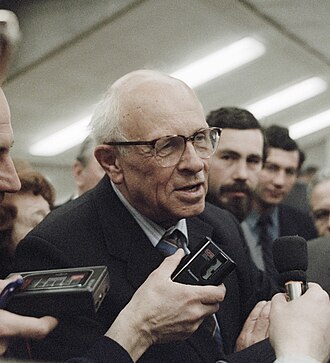 Andrei Sakharov1921 – 1989Soviet nuclear physicist and human rights activist (1921–1989)Source: Wikidata (citizenship)
 Konstantin Tsiolkovsky1857 – 1935Russian and Soviet rocket scientist and pioneer of the astronautic theory (1857-1935)Source: Wikidata (citizenship)
 Marc Chagall1887 – 1985Belarusian-French artist (1887–1985)Source: Wikidata (citizenship)
 Pyotr Kapitsa1894 – 1984Soviet physicistSource: Wikidata (citizenship)
 Andrey Kolmogorov1903 – 1987Russian mathematician (1903–1987)Source: Wikidata (citizenship)
 Mikhail Ivanovich Kalinin1875 – 1946Soviet politician (1875–1946)Source: Wikidata (citizenship)
 Nikolay Basov1922 – 2001Soviet physicist (1922-2001)Source: Wikidata (citizenship)
 Osip Mandelstam1891 – 1938Russian poet and essayist (1891-1938)Source: Wikidata (citizenship)
 Vladimir Vernadsky1863 – 1945Russian and Soviet mineralogist and geochemist, one of the founders of geochemistry, biogeochemistry, and of radiogeologySource: Wikidata (citizenship)
 Konstantin Rokossovsky1889 – 1968Soviet and Polish military commander (1896-1968)Source: Wikidata (citizenship)
 Roman Jakobson1896 – 1982Russian linguist (1896–1982)Source: Wikidata (citizenship)
 Anatoly Lunacharsky1875 – 1933Russian Soviet revolutionary, politician and writer (1875–1933)Source: Wikidata (citizenship)
 Nikolai Vavilov1887 – 1943Russian (Soviet) agronomist, botanist and geneticist (1887-1943)Source: Wikidata (citizenship)
 Feodor Chaliapin1873 – 1938Russian opera singer and actor (1873-1938)Source: Wikidata (citizenship)
 Dziga Vertov1896 – 1954Russian-Soviet documentary/avantgarde filmmaker (1896-1954)Source: Wikidata (citizenship)
 Velimir Khlebnikov1885 – 1922Russian writer (1885–1922)Source: Wikidata (citizenship)
 Vera Mukhina1889 – 1953Soviet sculptor (1889-1953)Source: Wikidata (citizenship)
 Varlam Shalamov1907 – 1982Soviet writer, journalist, poet and Gulag survivorSource: Wikidata (citizenship)
 Andrei Platonov1899 – 1951Russian author (1899–1951)Source: Wikidata (citizenship)
 Pitirim Sorokin1889 – 1968Russian sociologist (1889-1968)Source: Wikidata (citizenship)
 Faina Ranevskaya1896 – 1984Soviet actress (1896-1984)Source: Wikidata (citizenship)
 Lev Gumilev1912 – 1992Soviet academic (1912-1992)Source: Wikidata (citizenship)
 Lyubov Orlova1902 – 1975Soviet actress and singer (1900–1975)Source: Wikidata (citizenship)
 Dmitry Borisovich Kabalevsky1904 – 1987Composer, conductor (music), pianist, music teacherSource: Wikidata (citizenship)
 Alexander Grin1880 – 1932Russian writer (1880–1932)Source: Wikidata (citizenship)
 Viktor Shklovsky1893 – 1984Soviet Jewish writerSource: Wikidata (citizenship)
 Vasily Blyukher1890 – 1938Soviet marshal (1889–1938)Source: Wikidata (citizenship)
Everything that happened
- 1917 – 1922Russian Civil WarRussian RepublicThe Russian Civil War was a multi-party civil war in the former Russian Empire, lasting from 1917 to 1922, sparked by the overthrowing of the Russian Provisional Government in the October Revolution, as many factions vied to determine Russia's political future. It resulted in the formation of the Russian Socialist Federative Soviet Republic and later the Soviet Union in most of its territory.Source: Wikidata (country of the location)
- 1918Murder of the Romanov familyIpatiev HouseMembers of the Romanov family–the former Emperor Nicholas II of Russia, Empress Alexandra, and their children, Olga, Tatiana, Maria, Anastasia, and Alexei–were shot and stabbed to death by Bolshevik revolutionaries under Yakov Yurovsky on the orders of the Ural Regional Soviet in Yekaterinburg on the night of 16–17 July 1918.Source: Wikidata (country)
- 1918Left SR uprisingMoscowThe Left SR uprising, or Left SR revolt, was a rebellion against the Bolsheviks by the Left Socialist Revolutionary Party in Moscow, Soviet Russia, on 6–7 July 1918. It was one of a number of left-wing uprisings against the Bolsheviks that took place during the Russian Civil War.Source: Wikidata (country)
- 1920Nikolayevsk incidentNikolayevsk-on-AmurThe Nikolayevsk incident or Nikolaevsk incident (Russian: Николаевский инцидент) was a series of mass killings that took place in the region of Nikolayevsk-on-Amur during the Russian Civil War.Source: Wikidata (country)
- 1921Kronstadt rebellionKronstadtThe Kronstadt rebellion (Russian: Кронштадтское восстание, romanized: Kronshtadtskoye vosstaniye) was a 1921 insurrection of Soviet sailors, naval infantry, and civilians against the Bolshevik government in the Russian port city of Kronstadt. Located on Kotlin Island in the Gulf of Finland, Kronstadt defended the former capital city, Petrograd (now Saint Petersburg), as the base of the Baltic Fleet.Source: Wikidata (country)
- 1921 – 1922East Karelian uprisingRussian Socialist Federative Soviet RepublicThe East Karelian Uprising (Finnish: itäkarjalaisten kansannousu, Karelian: päivännouzu karjalan kanzannouzu) and the Soviet–Finnish conflict 1921–1922 were an attempt by a group of East Karelian separatists supported by Finland to gain independence from the Russian Soviet Federative Socialist Republic. They were aided by a number of Finnish volunteers, starting from 6 November 1921.Source: Wikidata (country)
- 1921Treaty of MoscowMoscowThe Treaty of Moscow, or Treaty of Brotherhood (Turkish: Moskova Antlaşması, Russian: Московский договор) was an agreement between the Grand National Assembly of Turkey (TBMM), under the leadership of Mustafa Kemal, and Russia, under the leadership of Vladimir Lenin, signed on 16 March 1921. Neither the Republic of Turkey nor the Soviet Union had then been established.Source: Wikidata (country)
- 1922Treaty of RapalloRapalloThe Treaty of Rapallo was an agreement signed on 16 April 1922 between Germany and Russia under which both renounced all territorial and financial claims against each other and opened friendly diplomatic relations. The treaty was negotiated by Russian foreign minister Georgi Chicherin and German foreign minister Walther Rathenau.Source: Wikidata (country)