Former state · 538 CE – 1791
Kingdom of France
20 events
The Kingdom of France is the historiographical name or umbrella term given to various political entities of France in the medieval and early modern period. It was one of the most powerful states in Europe from the High Middle Ages to 1848 during its dissolution. It was also an early colonial power, with colonies in Asia and Africa, and the largest being New France in North America geographically centred on the Great Lakes.
Text from the Wikipedia article Kingdom of France, CC BY-SA 4.0
Built from Wikidata: an event or person is listed when Wikidata links them to this page, as shown next to each one. Many aren’t recorded there, so this list is incomplete.
Showing 1,441 years
Countries on this land today
Key people
 Voltaire1694 – 1778French writer, historian and philosopher (1694–1778)Source: Wikidata (citizenship)
 Molière1622 – 1673French playwright and actor (1622–1673)Source: Wikidata (citizenship)
 Blaise Pascal1623 – 1662French mathematician, physicist, inventor, writer, and Christian philosopher (1623-1662)Source: Wikidata (citizenship)
 Joan of Arc1412 – 1431French folk heroine (1412–1431), military leader who crowned Charles VII and Roman Catholic saint, canonized 500 years after her deathSource: Wikidata (citizenship)
 Louis XIV of France1638 – 1715King of France and Navarre from 1643 to 1715 (1638-1715)Source: Wikidata (citizenship)
 Montesquieu1689 – 1755French philosopher (1689–1755)Source: Wikidata (citizenship)
 Jacques Cartier1491 – 1557Breton maritime explorer of North America (1491–1557)Source: Wikidata (citizenship)
 Denis Diderot1713 – 1784French Enlightenment philosopher writer and encyclopædist (1713–1784)Source: Wikidata (citizenship)
 Jean de La Fontaine1621 – 1695French poet, fabulist and writer (1621–1695)Source: Wikidata (citizenship)
 Michel de Montaigne1533 – 1592French author, philosopher, and statesman (1533–1592)Source: Wikidata (citizenship)
 John Calvin1509 – 1564French Protestant reformer (1509–1564)Source: Wikidata (citizenship)
 François Rabelais1494 – 155316th-century French writer and humanist (1494–1553)Source: Wikidata (citizenship)
 Nostradamus1503 – 1566French seer and astrologer (1503–1566)Source: Wikidata (citizenship)
 Jean Racine1639 – 1699French dramatist (1639-1699)Source: Wikidata (citizenship)
 Jean Le Rond d'Alembert1717 – 1783French mathematician, mechanician, physicist, philosopher and music theorist (1717-1783)Source: Wikidata (citizenship)
 Charles Perrault1628 – 1703French author (1628-1703)Source: Wikidata (citizenship)
 Pierre Corneille1606 – 1684French tragedian (1606–1684)Source: Wikidata (citizenship)
 Marquis de Sade1740 – 1814French nobleman, revolutionary politician, philosopher and writer of erotic worksSource: Wikidata (citizenship)
 Armand-Jean du Plessis, duc de Richelieu1585 – 1642French clergyman, cardinal, noble and statesman (1585-1642)Source: Wikidata (citizenship)
 Henry IV of France1553 – 1610King of Navarre from 1572 to 1610 and King of France from 1589 to 1610 (1553-1610)Source: Wikidata (citizenship)
 Peter Abelard1079 – 1142French scholastic philosopher, theologian and preeminent logician (c.1079-1142)Source: Wikidata (citizenship)
 François Villon1431 – 1463French poet and criminalSource: Wikidata (citizenship)
 Louis XIII of France1601 – 1643King of France and Navarre from 1610 to 1643 (1601–1643)Source: Wikidata (citizenship)
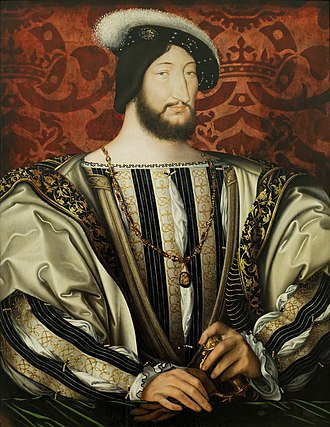 Francis I of France1494 – 1547King of France from 1515 to 1547 (1494-1547)Source: Wikidata (citizenship)
 Anselm of Canterbury1033 – 110911th‑century Benedictine monk, Archbishop of Canterbury, philosopher and theologianSource: Wikidata (citizenship)
 Bernard of Clairvaux1091 – 1153Burgundian saint, abbot and theologian (1090–1153)Source: Wikidata (citizenship)
 Nicolas Poussin1594 – 1665French painter (1594-1665)Source: Wikidata (citizenship)
 Louis XVIII of France1755 – 1824King of France and Navarre from 1814 to 1815 and from 1815 to 1824 (1755-1824)Source: Wikidata (citizenship)
 Charles VI of France1368 – 1422King of France from 1380 to 1422 (1368–1422)Source: Wikidata (citizenship)
 Philip V of Spain1683 – 1746King of Spain from 1700 to 1746 (1683–1746)Source: Wikidata (citizenship)
 Samuel de Champlain1567 – 163516/17th-century French explorer of North AmericaSource: Wikidata (citizenship)
 Henry II of France1519 – 1559King of France from 1547 to 1559 (1519–1559)Source: Wikidata (citizenship)
 Honoré Gabriel Riqueti, comte de Mirabeau1749 – 1791French writer, orator and statesman (1749-1791)Source: Wikidata (citizenship)
 Jean-Philippe Rameau1683 – 1764French composer and music theorist (1683–1764)Source: Wikidata (citizenship)
 Jean-Antoine Watteau1684 – 1721French painter (1684-1721)Source: Wikidata (citizenship)
 Jean-Baptiste Lully1632 – 1687Italian-born French composer (1632–1687)Source: Wikidata (citizenship)
 Adelbert von Chamisso1781 – 1838German poet and botanist (1781–1838)Source: Wikidata (citizenship)
 Nicolas Louis de Lacaille1713 – 1762French astronomerSource: Wikidata (citizenship)
 Margaret of Valois-Angoulême1492 – 1549Queen consort of Navarre (1492–1549)Source: Wikidata (citizenship)
 Michael Servetus1511 – 1553Spanish physician and theologianSource: Wikidata (citizenship)
 Charles the Bold1433 – 1477Last Valois Duke of Burgundy (1433-1477)Source: Wikidata (citizenship)
 Bernard Le Bovier de Fontenelle1657 – 1757French writer and philosopher of the enlightenment (1657–1757)Source: Wikidata (citizenship)
 Robert II of France972 CE – 1031King of the Franks from 996 to 1031Source: Wikidata (citizenship)
 Pierre Gassendi1592 – 1655French philosopher, astronomer, mathematician, priest, and scientist (*1592 – †1655)Source: Wikidata (citizenship)
 Philip III the Good1396 – 1467Duke of Burgundy from 1419 to 1467 (1396-1467)Source: Wikidata (citizenship)
 Denis Papin1647 – 1713French physicist, mathematician and inventor (1647–1713)Source: Wikidata (citizenship)
 Guillaume Dufay1397 – 1474Composer of the Renaissance (1397–1474)Source: Wikidata (citizenship)
 Gregory of Tours538 CE – 594 CEGallo-Roman historian and Bishop of ToursSource: Wikidata (country of birthplace)
Showing the 48 best-known of 57 people.
Everything that happened
- 1202 – 1214First Hundred Years' WarKingdom of FranceThe First Hundred Years' War (French: Première Guerre de Cent Ans; 1159–1259) was a series of conflicts and disputes during the High Middle Ages in which the House of Capet, rulers of the Kingdom of France, fought the House of Plantagenet (also known as the House of Anjou or the Angevins), rulers of the Kingdom of England.Source: Wikidata (country of the location)
- 1214Battle of BouvinesBouvinesThe Battle of Bouvines took place on 27 July 1214 near the town of Bouvines in the County of Flanders. It was the concluding battle of the Anglo-French War of 1213–1214. Although estimates on the number of troops vary considerably among modern historians, at Bouvines, a French army commanded by King Philip Augustus routed a larger allied army led by Holy Roman Emperor Otto IV in one of the rare pitched battles of…Source: Wikidata (country)
- 1415Battle of AgincourtAzincourtThe Battle of Agincourt ( AJ-in-kor(t); French: Azincourt [azɛ̃kuʁ]) was an English victory in the Hundred Years' War (1337–1453). It took place on 25 October 1415 (Saint Crispin's Day) near Azincourt, in northern France. The unexpected victory of the vastly outnumbered English troops over the French army boosted English morale, crippled France, and began a new period of English dominance in the war.Source: Wikidata (country)
- 1421Battle of BaugéBaugéThe Battle of Baugé, fought between the English and a Franco-Scots army on 22 March 1421 at Baugé, France, east of Angers, was a major defeat for the English in the Hundred Years' War.Source: Wikidata (country)
- 1428 – 1429Siege of OrléansOrléansThe siege of Orléans (12 October 1428 – 8 May 1429) marked a turning point of the Hundred Years' War between France and England. The siege took place at the pinnacle of English power during the later stages of the war, but was repulsed by French forces inspired by the arrival of Joan of Arc.Source: Wikidata (country)
- 1440PraguerieKingdom of FranceThe Praguerie (French pronunciation: [pʁaɡʁi]) was a revolt of the French nobility against King Charles VII from February to July 1440.Source: Wikidata (country)
- 1474Battle of HéricourtHéricourtThe Battle of Héricourt was fought on 13 November 1474 near Héricourt, Burgundy, as part of the Burgundian Wars. It resulted in victory for the Swiss Confederacy and its allies over the Burgundian State.Source: Wikidata (country)
- 1474 – 1477Burgundian WarsDuchy of LorraineThe Burgundian Wars (1474–1477) were a conflict between the Burgundian State and the Old Swiss Confederacy and its allies. Open war broke out in 1474, and the Duke of Burgundy, Charles the Bold, was defeated three times on the battlefield in the following years and was killed at the Battle of Nancy in 1477.Source: Wikidata (country of the location)
- 1476 – 1477Battle of NancyNancyThe Battle of Nancy was the final and decisive battle of the Burgundian Wars, fought on 5 January 1477 outside the walls of Nancy, Lorraine by Charles the Bold, Duke of Burgundy, against René II, Duke of Lorraine, and the Swiss Confederacy. René's forces won the battle, and Charles' mutilated body was found two days later.Source: Wikidata (country)
- 1485 – 1488Mad WarKingdom of FranceThe Mad War (French: la Guerre folle) was a late medieval conflict between a coalition of feudal lords and the French monarchy. It occurred during the regency of Anne of Beaujeu in the period after the death of Louis XI and before the majority of Charles VIII. The war began in 1485 and ended in 1488.Source: Wikidata (country of the location)
- 1508 – 1516War of the League of CambraiItalian PeninsulaThe War of the League of Cambrai, also known by its second stage as the War of the Holy League, was fought from December 1508 to December 1516, as part of the wider Italian Wars of 1494–1559.Source: Wikidata (country of the location)
- 1572St. Bartholomew's Day massacreParisThe Saint Bartholomew's Day massacre (French: Massacre de la Saint-Barthélemy) in 1572 was a targeted group of assassinations and a wave of Catholic mob violence directed against the Huguenots (French Calvinist Protestants) during the French Wars of Religion.Source: Wikidata (country)
- 1590Battle of IvryIvry-la-BatailleThe Battle of Ivry was fought on 14 March 1590, during the French Wars of Religion. The battle was a decisive victory for Henry IV of France, leading French royal and English forces against the Catholic League under the Duc de Mayenne and Spanish forces under the Count of Egmont. Henry's forces were victorious and he went on to lay siege to Paris.Source: Wikidata (country)
- 1627 – 1628Siege of La RochelleLa RochelleThe siege of La Rochelle (French: le siège de La Rochelle, or sometimes le grand siège de La Rochelle) was a result of a war between the French royal forces of King Louis XIII and the Huguenots of La Rochelle in 1627–1628. The siege marked the height of the struggle between the Catholics and the Protestants in France and French territories, and ended with a complete victory for Louis XIII and the Catholics.Source: Wikidata (country)
- 1643Battle of RocroiRocroiThe Battle of Rocroi, fought on 19 May 1643, was a major engagement of the Thirty Years' War between a French army, led by the 21-year-old Duke of Enghien (later known as the Great Condé) and Spanish forces under General Francisco de Melo only five days after the accession of Louis XIV to the throne of France after his father's death.Source: Wikidata (country)
- 1707Siege of ToulonToulonThe siege of Toulon took place between 29 July and 21 August 1707 during the War of the Spanish Succession, when a combined Savoyard-Imperial army supported by a British naval force, attacked the French base at Toulon.Source: Wikidata (country)
- 1708Siege of LilleLilleThe siege of Lille (12 August – 10 December 1708) was the main operation of the 1708 campaign season during the War of the Spanish Succession. Following their victory in the Battle of Oudenaarde, the Allies decided to besiege Lille, an important French city and perhaps the strongest fortress in Europe.Source: Wikidata (country)
- 1717Triple AllianceDutch RepublicThe Triple Alliance was a defence pact signed on 4 January 1717 in The Hague between the Dutch Republic, France and Great Britain, against Bourbon Spain in an attempt to maintain the agreements of the 1713–15 Peace of Utrecht. The three states were concerned about Spain becoming a superpower in Europe. As a result, militarisation took place and caused great havoc to civilians.Source: Wikidata (country)
- 1744Battle of ToulonToulonThe Battle of Toulon took place on 21 and 22 February 1744 NS near the French Mediterranean port of Toulon. Although France was not yet at war with Britain, ships from their Levant Fleet supported an attempt by a Spanish force trapped in Toulon to break through the British Mediterranean Fleet.Source: Wikidata (country)
- 1778Battle of UshantOuessantThe Battle of Ushant (also called the First Battle of Ushant) took place on 27 July 1778, and was fought during the American Revolutionary War between French and British fleets 100 miles (160 km) west of Ushant, an island at the mouth of the English Channel off the westernmost point of France.Source: Wikidata (country)