Former state · 1834 – 1933
Weimar Republic
4 events
The Weimar Republic was a historical period of the German state from 9 November 1918 to 23 March 1933, during which it was a constitutional republic for the first time in history. The state was officially named the German Reich, but was more commonly referred to, and unofficially proclaimed itself, as the German Republic. The period's informal name is derived from the city of Weimar,
Text from the Wikipedia article Weimar Republic, CC BY-SA 4.0
Built from Wikidata: an event or person is listed when Wikidata links them to this page, as shown next to each one. Many aren’t recorded there, so this list is incomplete.
Showing 114 years
Key people
 Albert Einstein1879 – 1955German-born theoretical physicist (1879–1955)Source: Wikidata (citizenship)
 Marlene Dietrich1901 – 1992German and American actress and singer (1901–1992)Source: Wikidata (citizenship)
 Max Weber1864 – 1920German sociologist, philosopher, and political economist (1864–1920)Source: Wikidata (citizenship)
 Anne Frank1929 – 1945German-born Dutch Jewish diarist and Holocaust victim (1929–1945)Source: Wikidata (citizenship)
 David Hilbert1862 – 1943German mathematician (1862–1943)Source: Wikidata (citizenship)
 Wilhelm Röntgen1845 – 1923German physicist (1845–1923)Source: Wikidata (citizenship)
 Bertolt Brecht1898 – 1956German poet, playwright, and theatre director (1898–1956)Source: Wikidata (citizenship)
 Martin Heidegger1889 – 1976German philosopher (1889–1976)Source: Wikidata (citizenship)
 Helmut Kohl1930 – 2017Chancellor of West Germany and reunified Germany (1982–1998)Source: Wikidata (citizenship)
 Gerhart Hauptmann1862 – 1946German dramatist who received the Nobel Prize in Literature in 1912 (1862-1946)Source: Wikidata (citizenship)
 Heinrich Himmler1900 – 1945German Nazi politician; leader of the German SS & main architect of the Holocaust (1900-1945)Source: Wikidata (citizenship)
 Erwin Rommel1891 – 1944German field marshal (1891–1944)Source: Wikidata (citizenship)
 Clara Zetkin1857 – 1933Communist activist, and advocate for women's rights (1857–1933)Source: Wikidata (citizenship)
 Wernher von Braun1912 – 1977German and later American aerospace engineer and space architect (1912–1977)Source: Wikidata (citizenship)
 Ernst Haeckel1834 – 1919German zoologist (1834-1919)Source: Wikidata (citizenship)
 Erich Fromm1900 – 1980German-American sociologist and psychoanalyst (1900–1980)Source: Wikidata (citizenship)
 Rudolf Christoph Eucken1846 – 1926(1846-1926) German philosopherSource: Wikidata (citizenship)
 Shmuel Yosef Agnon1887 – 1970Ukrainian-born Israeli Hebrew writer, Nobel laureate in Literature (1888–1970)Source: Wikidata (citizenship)
 Otto Hahn1879 – 1968German chemist and physicist (1879-1968)Source: Wikidata (citizenship)
 Fritz Haber1868 – 1934German chemist and receiver of the Nobel prize (1868–1934)Source: Wikidata (citizenship)
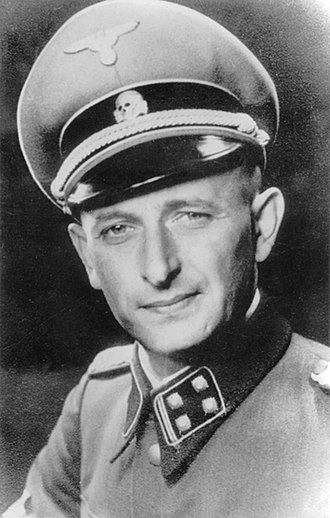 Adolf Eichmann1906 – 1962German-Austrian SS officer and one of the major organizers of the Holocaust (1906–1962)Source: Wikidata (citizenship)
 Leni Riefenstahl1902 – 2003German filmmaker, photographer, actress, and nazi propagandist (1902–2003)Source: Wikidata (citizenship)
 Walter Gropius1883 – 1969German-American architect (1883–1969)Source: Wikidata (citizenship)
 James Franck1882 – 1964German-American physicist (1882–1964)Source: Wikidata (citizenship)
 Emanuel Lasker1868 – 1941Greman chess player, World Chess champion (1868–1941)Source: Wikidata (citizenship)
 Herbert Marcuse1898 – 1979German philosopher, sociologist, and political theorist (1898–1979)Source: Wikidata (citizenship)
 Walther Hermann Nernst1864 – 1941German physical chemist and physicist (1864–1941)Source: Wikidata (citizenship)
 Martin Buber1878 – 1965German Jewish Existentialist philosopher and theologian (1878–1965)Source: Wikidata (citizenship)
 Josef Mengele1911 – 1979Nazi SS doctor and Military Officer at Auschwitz (1911–1979)Source: Wikidata (citizenship)
 Hermann Weyl1885 – 1955German mathematician (1885–1955)Source: Wikidata (citizenship)
 Ernst Ruska1906 – 1988German physicist (1906–1988)Source: Wikidata (citizenship)
 Nikolai Berdyaev1874 – 1948Russian philosopher (1874–1948)Source: Wikidata (citizenship)
 Alfred Rosenberg1893 – 1946Baltic German architect, Nazi politician and ideologue (1893-1946)Source: Wikidata (citizenship)
 Erich Kästner1899 – 1974German children's writer (1899–1974)Source: Wikidata (citizenship)
 Felix Klein1849 – 1925German mathematician, author of the Erlangen Program (1849-1925)Source: Wikidata (citizenship)
 Eduard Bernstein1850 – 1932German politician and theorist (1850–1932)Source: Wikidata (citizenship)
 Alfred Jodl1890 – 1946German general and convicted war criminal (1890–1946)Source: Wikidata (citizenship)
 Friedrich Paulus1890 – 1957German general (1890–1957)Source: Wikidata (citizenship)
 Rudolf Carnap1891 – 1970German philosopher and logician (1891–1970)Source: Wikidata (citizenship)
 Richard Willstätter1872 – 1942German chemist (1872–1942)Source: Wikidata (citizenship)
 Otto Heinrich Warburg1883 – 1970German physiologist, medical doctor and Nobel laureate (1883–1970)Source: Wikidata (citizenship)
 Hans Fischer1881 – 1945German chemist (1881–1945)Source: Wikidata (citizenship)
 Ernst Thälmann1886 – 1944German communist politician, leader of Communist Party of Germany (1886–1944)Source: Wikidata (citizenship)
 Ernst Cassirer1874 – 1945German philosopher (1874–1945)Source: Wikidata (citizenship)
 Lion Feuchtwanger1884 – 1958German writer (1884-1958)Source: Wikidata (citizenship)
 Klaus Mann1906 – 1949German writer (1906–1949)Source: Wikidata (citizenship)
 Käthe Kollwitz1867 – 1945German printmaker and sculptor (1867–1945)Source: Wikidata (citizenship)
 Heinrich Otto Wieland1877 – 1957German Nobel laureate in Chemistry (1877-1957)Source: Wikidata (citizenship)
Showing the 48 best-known of 56 people.
Everything that happened
- 1918November 1918 insurgency in Alsace–LorraineWeimar RepublicThe Alcase-Lorraine insurrectionary movement started by returning German soldiers, local workers, and sailors during the First World War, inspired by communist workers' and soldiers' councils in several cities of Alsace–Lorraine from November 8 to November 22, 1918, as well as the German revolution of 1918–1919. Insurrectionists hoisted a red flag was atop Strasbourg Cathedral.Source: Wikidata (country)
- 1922Treaty of RapalloRapalloThe Treaty of Rapallo was an agreement signed on 16 April 1922 between Germany and Russia under which both renounced all territorial and financial claims against each other and opened friendly diplomatic relations. The treaty was negotiated by Russian foreign minister Georgi Chicherin and German foreign minister Walther Rathenau.Source: Wikidata (country)
- 19321932 Prussian coup d'étatWeimar RepublicThe 1932 Prussian coup d'état or Preußenschlag (German pronunciation: [ˈpʁɔʏsənˌʃlaːk]; lit. 'Prussian hit') took place on 20 July 1932, when Reich President Paul von Hindenburg, at the request of Franz von Papen, then Reich Chancellor of Germany, replaced the legal government of the Free State of Prussia with von Papen as Reich Commissioner.Source: Wikidata (country)
- 1932Altona Bloody SundayWeimar RepublicAltona Bloody Sunday (German: Altonaer Blutsonntag) is the name given to the events of 17 July 1932 when a recruitment march by the Nazi SA led to violent clashes between the police, the SA and supporters of the Communist Party of Germany (KPD) in Altona, which at the time belonged to the Prussian province of Schleswig-Holstein but is now part of Hamburg. Eighteen people were killed.Source: Wikidata (country)