Saudi Arabia
39 events
Saudi Arabia, officially the Kingdom of Saudi Arabia (KSA), is a country in West Asia that occupies the bulk of the Arabian Peninsula. Covering a land area of approximately 2,149,690 km2 (830,000 sq mi), it is the fifth-largest country in Asia and the twelfth-largest in the world. It is bordered by the Red Sea to the west, Jordan, Iraq, and Kuwait to the north, the Persian Gulf, Bahrain, Qatar, and the United Arab Emirates to the east, Oman to the southeast, and Yemen to the south. The Gulf of Aqaba in the northwest separates it from Egypt and Israel.
Text from the Wikipedia article Saudi Arabia, CC BY-SA 4.0
Built from Wikidata: an event or person is listed when Wikidata links them to this page, as shown next to each one. Many aren’t recorded there, so this list is incomplete.
Key people
 Osama bin Laden1957 – 2011Founder of al-Qaeda (1957–2011)Source: Wikidata (citizenship)
 Umar ibn Al-Khattāb586 CE – 644 CE2nd Rashidun Caliph from 634 to 644Source: Wikidata (country of birthplace)
 Alī ibn Abī Ṭālib599 CE – 661 CE4th Rashidun Caliph (r. 656–661) and first Shia ImamSource: Wikidata (country of birthplace)
 Abu Bakr573 CE – 634 CE1st Rashidun Caliph and father-in-law of MuhammadSource: Wikidata (country of birthplace)
 Idi Amin1925 – 2003President of Uganda (1971-1979)Source: Wikidata (citizenship)
 Abdullah of Saudi Arabia1924 – 2015King of Saudi Arabia from 2005 to 2015 (1924–2015)Source: Wikidata (citizenship)
 Uthman ibn Affan574 CE – 656 CECaliph of the Rashidun Caliphate from 644 to 656Source: Wikidata (country of birthplace)
 Aisha614 CE – 678 CEMuhammad's third wife (c. 613/614 – 678)Source: Wikidata (country of birthplace)
- Husayn ibn Ali626 CE – 680 CEGrandson of Muhammad and the 3rd Shia Imam (626–680)Source: Wikidata (country of birthplace)
 Salman bin Abdulaziz Al Saudb. 1935King of Saudi Arabia since 2015Source: Wikidata (citizenship)
 Fatima604 CE – 632 CEDaughter of Muhammad (c. 605–632)Source: Wikidata (country of birthplace)
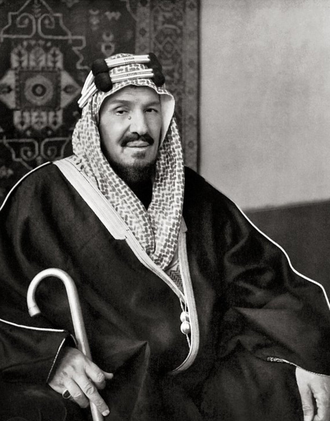 Ibn Saud1876 – 1953King of Saudi Arabia from 1932 to 1953Source: Wikidata (citizenship)
 Khadija bint Khuwaylidc. 557 CE – 619 CEFirst wife of Prophet Muḥammad ﷺ, First believer in Islam and Prophet Muhammad’s most beloved wifeSource: Wikidata (country of birthplace)
 Mohammed bin Salman Al Saudb. 1985Saudi crown prince (born 1985)Source: Wikidata (citizenship)
 Mu'awiya I603 CE – 680 CEFounder and first caliph of the Umayyad Caliphate (r. 661–680)Source: Wikidata (country of birthplace)
 Jamal Khashoggi1958 – 2018Saudi journalist (1958–2018)Source: Wikidata (citizenship)
 King Faisal bin Abdulaziz Al Saud1906 – 1975King of Saudi Arabia from 1964 to 1975Source: Wikidata (citizenship)
 Ahmed al-Sharaab. 1982President of Syria since 2025Source: Wikidata (country of birthplace)
 Fahd bin Abdulaziz Al Saud1921 – 2005King of Saudi Arabia from 1982 to 2005Source: Wikidata (citizenship)
 Khalid ibn al-Walid586 CE – 642 CEArab Muslim military general (d. 642)Source: Wikidata (country of birthplace)
 Abd al-Malik ibn Marwan646 CE – 705 CEUmayyad caliph from 685 to 705Source: Wikidata (country of birthplace)
 Faisal I of Iraq1885 – 19331st king of Hashemite Iraq from 1921 to 1933Source: Wikidata (country of birthplace)
 Malik ibn Anas711 CE – 795 CEArab Islamic jurist, theologian and hadith traditionist (711–795)Source: Wikidata (country of birthplace)
 Abdullah I of Jordan1882 – 1951Ruler of Transjordan and Jordan from 1921 to 1951Source: Wikidata (country of birthplace)
 Umar II681 CE – 720 CEUmayyad caliph from 717 to 720Source: Wikidata (country of birthplace)
 Aminahc. 550 CE – 575 CEMother of MuhammadSource: Wikidata (country of birthplace)
 Saud of Saudi Arabia1902 – 1969King of Saudi Arabia from 1953 to 1964Source: Wikidata (citizenship)
 Rafiq Hariri1944 – 2005Prime Minister of Lebanon (1992–1998, 2000–2004)Source: Wikidata (citizenship)
 Khalid of Saudi Arabia1911 – 1982King of Saudi Arabia (1911-1982)Source: Wikidata (citizenship)
 Muhammad ibn Abd al-Wahhab1703 – 1792Islamic Saudi scholar, jurist and eponym of Wahhabi movement (1703–1792)Source: Wikidata (country of birthplace)
 Saad Harirịb. 1970Saudi Lebanese and france politicianSource: Wikidata (citizenship)
 Abul Kalam Azad1888 – 1958Indian politician and writer (1888–1958)Source: Wikidata (country of birthplace)
- Abd Allah ibn al-Zubayr624 CE – 692 CEHistorical Arab ruler (624-692)Source: Wikidata (country of birthplace)
 Abu Talib ibn ‘Abd al-Muttalib540 CE – 619 CELeader of Banu Hashim, a clan of the Qurayshi tribe of Mecca (c.535-c.619)Source: Wikidata (country of birthplace)
- Abd Allah ibn Abbas619 CE – 688 CE7th-century Islamic scholarSource: Wikidata (country of birthplace)
 Marwan I623 CE – 685 CEFourth Umayyad caliph from 684 to 685Source: Wikidata (country of birthplace)
- 'Amr ibn al-'As570 CE – 664 CEArab military commander and governor (c.573–664)Source: Wikidata (country of birthplace)
 Ali ibn al-Husayn Zayn al-'Abidin659 CE – 713 CEGreat-grandson of Muhammad and the fourth of the Shiite ImamsSource: Wikidata (country of birthplace)
 Ali al-Rida770 CE – 818 CEEighth of the Twelve Shia Imams (766–818)Source: Wikidata (country of birthplace)
 Zakir Naikb. 1965Indian Islamic preacherSource: Wikidata (citizenship)
 Loujain al-Hathloulb. 1989Saudi Arabian activistSource: Wikidata (citizenship)
 Nimr al-Nimr1959 – 2016Saudi Shia Sheikh in al-Awamiyah in Saudi Arabia's Eastern ProvinceSource: Wikidata (citizenship)
 Zubayr ibn al-Awwam594 CE – 656 CECompanion of Muhammad (594–656)Source: Wikidata (country of birthplace)
 Al-Walid I668 CE – 715 CEUmayyad caliphSource: Wikidata (country of birthplace)
 Sulayman ibn Abd al-Malik675 CE – 717 CEUmayyad caliphSource: Wikidata (country of birthplace)
 Talal I of Jordan1909 – 1972King of Jordan from 1951 to 1952Source: Wikidata (country of birthplace)
 Abd al-Muttalib497 CE – 579 CEChief Leader of the Quraysh and grandfather of Muhammad (c.497–578)Source: Wikidata (country of birthplace)
 Manal al-Sharifb. 1979Saudi Arabian activistSource: Wikidata (citizenship)
Showing the 48 best-known of 49 people.
Everything that happened
- 494 CE – 534 CEBasus WarNajdThe Basus War (often written al-Basus War; Arabic: حرب البسوس ḥarb al-basūs) is a famous conflict narrative from the corpus of the ayyām al-ʿarab (Days of the Arabs), traditionally dated to late pre-Islamic Arabia and showcasing the rivalry of the tribes of Taghlib and Bakr.Source: Wikidata (country of the location)
- 624 CEBattle of BadrBadrThe Battle of Badr or sometimes called The Raid of Badr (Arabic: غَزْوَةُ بَدْرٍ [ɣazwatu badr]; Ghazwatu Badr), also referred to as The Day of the Criterion (Arabic: يَوْمُ الْفُرْقَانْ, Arabic pronunciation: [jawm'ul fur'qaːn]; Yawm al-Furqan) in the Qur'an and by Muslims, was fought on 13 March 624 CE (17 Ramadan, 2 AH), near the city of Badr, Medina Province in present-day Saudi Arabia.Source: Wikidata (country)
- 624 CESiege of Banu QaynuqaMedinaThe siege of Banu Qaynuqa occurred in April 624. The Banu Qaynuqa were a Jewish tribe expelled by the Islamic prophet Muhammad for breaking the treaty known as the Constitution of Medina.Source: Wikidata (country)
- 625 CEBattle of UhudMount UhudThe Battle of Uhud (Arabic: غزوة أحد, romanized: Ghazwat ʾUḥud) was fought between the early Muslims and the Quraysh during the Muslim–Quraysh wars in a valley north of Medina near Mount Uhud on Saturday, 23 March 625 AD (7 Shawwal, 3 AH).Source: Wikidata (country)
- 627 CEBattle of the TrenchMedinaThe Battle of the Trench (Arabic: غزوة الخندق, romanized: Ghazwat al-Khandaq), also known as the Battle of Khandaq (Arabic: معركة الخندق, romanized: Ma’rakah al-Khandaq) and the Battle of the Confederates (Arabic: غزوة الاحزاب, romanized: Ghazwat al-Ahzab), was part of the conflict between the Muslims and the Quraysh.Source: Wikidata (country)
- 628 CEBattle of KhaybarKhaybarThe Battle of Khaybar (Arabic: غزوة خيبر, romanized: Ghazwatu Khaybar) was an armed confrontation between the early Muslims and the Jewish community of Khaybar in 628 CE. Khaybar, which is located approximately 150 kilometres (93 mi) to the northwest of Medina, was home to a sizable community of Jewish tribes.Source: Wikidata (country of the location)
- 630 CEBattle of HunaynHunaynThe Battle of Hunayn (Arabic: غَزْوَة حُنَيْن, romanized: Ġazwat Ḥunayn) was a conflict between the Muslims of the Islamic prophet Muhammad and the tribes of Qays in the aftermath of the conquest of Mecca. The battle took place in 8 AH (c. 630) in the Hunayn valley on the route from Mecca to Taif.Source: Wikidata (country of the location)
- 630 CESiege of Ta'ifTa'ifThe Siege of Ta'if took place in 630 CE, shortly after the Muslim victory at the battles of Hunayn and Autas that followed the conquest of Mecca. Seeking to consolidate control over the Hijaz, Muhammad marched with his forces to the fortified city of Ta'if, stronghold of the Thaqif tribe and a long-standing commercial rival of Mecca.Source: Wikidata (country)
- 632 CEBattle of al-YamamaAl-YamamaThe Battle of al-Yamama was fought in December 632 as part of the Ridda Wars against a rebellion within the Rashidun Caliphate in the region of al-Yamama (in present-day Saudi Arabia, South of Riyadh City) between the forces of Abu Bakr and Musaylima, a self-proclaimed prophet. This battle was a part of a multi-prolonged engagement in the plains of Aqrama and the city of Al-Hadiqat.Source: Wikidata (country of the location)
- 632 CEBattle of BuzakhaHa'ilThe Battle of Buzakha was a major military battle in the Ridda Wars or Wars of Apostasy. It took place between the army of the Rashidun Caliphate under command of Khalid ibn al-Walid and the Apostate forces under Tulayha, in September 632.Source: Wikidata (country)
- 632 CEBattle of ZafarHa'ilThe Battle of Zafar took place in 632 between Khalid ibn al-Walid, a companion of the Islamic prophet Muhammad, and a tribal chieftess called Salma. Khalid defeated her and she died on the battlefield. The battle was part of the Ridda Wars.Source: Wikidata (country of the location)
- 632 CE – 633 CERidda WarsArabian PeninsulaThe Ridda Wars were a series of military campaigns launched by the first Rashidun caliph Abu Bakr against rebellious Arabian tribes, some of which were led by rival prophethood claimants. These wars began shortly after the death of the Islamic prophet Muhammad in 632 and concluded the next year, with all battles won by the Rashidun Caliphate.Source: Wikidata (country of the location)
- 656 CEAssassination of UthmanMedina ProvinceUthman ibn Affan, the third Rashidun caliph, who ruled from 644 to 656, was assassinated at the end of a siege upon his house in 656. This was initially a protest but escalated into a siege following the death of a protester. The protesters-turned-rebels had demanded a new caliph, which Uthman refused. On 17 June 656 (35 AH) protestors set the house on fire, made their way inside, and killed him.Source: Wikidata (country)
- 683 CEBattle of al-HarraMedinaThe Battle of al-Harra (Arabic: يوم الحرة, romanized: Yawm al-Ḥarra, lit. 'Day of al-Harra') was fought between the Umayyad army of the caliph Yazid I (r. 680–683) led by Muslim ibn Uqba and the defenders of Medina from the Ansar and Muhajirun factions, who had rebelled against the caliph.Source: Wikidata (country)
- 683 CESiege of MeccaMeccaThe siege of Mecca in September–November 683 was one of the early battles of the Second Fitna. The city of Mecca was a sanctuary for Abd Allah ibn al-Zubayr, who was among the most prominent challengers to the hereditary succession to the Caliphate by Yazid I of the Umayyad dynasty. After nearby Medina, the other holy city of Islam, also rebelled against Yazid, the Umayyad ruler sent an army to subdue the Hejaz.Source: Wikidata (country)
- 692 CESiege of MeccaMeccaThe siege of Mecca in March–October/November 692 was the final battle of the of the Second Fitna, in which the forces of the Umayyad caliph Abd al-Malik ibn Marwan besieged and defeated his rival, the caliph Abd Allah ibn al-Zubayr in his center of power, the Islamic holy city of Mecca.Source: Wikidata (country)
- 762 CE – 763 CEAlid revolt of 762–763HejazThe Alid revolt of 762–763 or Revolt of Muhammad the Pure Soul was an uprising by the Hasanid branch of the Alids against the newly established Abbasid Caliphate. The Hasanids, led by the brothers Muhammad (called "the Pure Soul") and Ibrahim, rejected the legitimacy of the Abbasid family's claim to power.Source: Wikidata (country of the location)
- 786 CEBattle of FakhkhWadi al-ZahirThe Battle of Fakhkh (Arabic: يوم فخ, romanized: yawm Fakhkh, lit. 'Day of Fakhkh') was fought on 11 June 786 between the forces of the Abbasid Caliphate and the supporters of an Alid rebellion in Mecca under al-Husayn ibn Ali al-Abid, a descendant of Hasan ibn Ali.Source: Wikidata (country of the location)
- 1811 – 1818Ottoman–Wahhabi warArabian PeninsulaThe Ottoman–Wahhabi war, or Wahhabi war, was fought from early 1811 until 1818 between the Ottoman Empire, its vassal the Eyalet of Egypt, and the Wahhabis’ Emirate of Diriyah (later known as the first Saudi state), resulting in the destruction of the latter.Source: Wikidata (country of the location)
- 1813Capture of MeccaMeccaThe Capture of Mecca in 1813 took place several days after the Ottoman Capture of Jeddah in the First Campaign of the Ottoman–Wahhabi war.Source: Wikidata (country)
- 1915Treaty of DarinTarout IslandThe Treaty of Darin, or the Darin Pact, of 1915 was made between the United Kingdom and Abdulaziz Al Saud (sometimes called Ibn Saud), ruler of the Emirate of Nejd and Hasa, who founded the Kingdom of Saudi Arabia in 1932.Source: Wikidata (country of the location)
- 1916Battle of MeccaMeccaThe Battle of Mecca occurred in the Muslim holy city of Mecca in June and July 1916. On June 10, the Sharif of Mecca, Hussein bin Ali, the leader of the Banu Hashim clan, started a revolt against the Ottoman Caliphate from this city. The Battle of Mecca was part of the Arab Revolt of World War I.Source: Wikidata (country)
- 1916 – 1919Siege of MedinaMedinaThe siege of Medina lasted from 10 June 1916 to 10 January 1919, when Hejazi Arab rebels surrounded the Islamic holy city, which was then under the control of the Ottoman Empire.Source: Wikidata (country)
- 1922Uqair Protocol of 1922UqairThe Uqair Protocol or Uqair Convention was an agreement at Uqair on 2 December 1922 that defined the boundaries between Mandatory Iraq, the Sultanate of Nejd and Sheikhdom of Kuwait. It was made by Percy Cox, the British High Commissioner to Iraq, in response to Ikhwan raiders from Nejd under Ibn Saud attacking Kuwait. Cox met ibn Saud and Major John More, the British Political Agent to Kuwait.Source: Wikidata (country of the location)
- 1924Capture of MeccaMeccaThe Capture of Mecca took place on 5 December 1924 in Mecca, as part of the Saudi conquest of the Kingdom of Hejaz by King Abdulaziz Ibn Saud of the Sultanate of Nejd. The Hejaz region was ruled as a kingdom under King Hussein bin Ali of the Hashemite family.Source: Wikidata (country)
- 1927Treaty of JeddahJeddahThe 1927 Treaty of Jeddah, formally the Treaty between His Majesty and His Majesty the King of the Hejaz and of Nejd and Its Dependencies was signed between the United Kingdom and Ibn Saud.Source: Wikidata (country of the location)
- 1934Saudi–Yemeni warSaudi ArabiaThe Saudi–Yemeni war (Arabic: الحرب السعودية اليمنية) was a war between the Kingdom of Saudi Arabia and the Kingdom of Yemen in 1934.Source: Wikidata (country)
- 1980 – 1988Iran–Iraq WarIranThe Iran–Iraq War, also called the First Imposed War, Eight-Year War, or Sacred Defense by Iran, began with the Iraqi invasion of Iran in September 1980. After eight years of conflict, both countries accepted a ceasefire deal brokered by the United Nations, which became effective in August 1988.Source: Wikidata (country of the location)
- 1980Operation MorvaridPersian GulfOperation Morvarid (Persian: عملیات مروارید, lit. 'Operation Pearl') was an operation launched by the Iranian Navy and Air Force against the Iraqi Navy sites on 27 November 1980 in response to Iraq positioning radar and monitoring equipment on the Mina Al-Bakr and Khor-al-Amaya oil rigs to counter Iranian air operations.Source: Wikidata (country of the location)
- 1984 – 1988Tanker warPersian GulfThe tanker war, part of the larger Iran–Iraq War, was a series of military attacks by Iran and Iraq against merchant vessels in the Persian Gulf and Strait of Hormuz from 1981 to 1988. Iraq was responsible for 283 attacks. Iran accounted for 168.Source: Wikidata (country of the location)
- 1987 – 1988Operation Earnest WillPersian GulfOperation Earnest Will (24 July 1987 – 26 September 1988) was an American military protection of Kuwaiti-owned tankers from Iranian attacks in 1987 and 1988, three years into the Tanker War phase of the Iran–Iraq War. It was the largest naval convoy operation since World War II, and flowed from Resolution 598 which had been adopted three days earlier.Source: Wikidata (country of the location)
- 1988Operation Praying MantisPersian GulfOperation Praying Mantis was the 18 April 1988 attack by the United States on Iranian naval targets in the Persian Gulf in retaliation for the mining of a U.S. warship four days earlier. It took place during the US presidency of Ronald Reagan and the rule of Supreme Leader of Iran Ruhollah Khomeini.Source: Wikidata (country of the location)
- 1990 – 1991Invasion and liberation of KuwaitKuwaitIraq invades Kuwait on 2 August 1990. A US-led coalition liberates the country on 26 February 1991.Source: Wikidata (country of the location)
- 1991Battle of KhafjiKhafjiThe Battle of Khafji was the first major ground engagement of the Gulf War. It took place in and around the Saudi Arabian city of Khafji, from 29 January to 1 February 1991.Source: Wikidata (country)
- 2004Houthi insurgencySaada GovernorateThe Houthi insurgency, also known as the Sa'dah Wars, was a military rebellion pitting Zaidi Shia Houthis that began in northern Yemen and has since escalated into a full-scale civil war. The conflict was sparked in 2004 by the government's attempt to arrest Hussein al-Houthi, a Zaidi religious leader of the Houthis and a former parliamentarian on whose head the government had placed a $55,000 bounty.Source: Wikidata (country of the location)
- 2015Mecca crane collapseAl-Masjid Al-HaramA crawler crane collapsed over the Masjid al-Haram in Mecca, Saudi Arabia, around 5:10 p.m. on 11 September 2015, killing 111 people and injuring 394 others. The city was preparing for the Hajj pilgrimage. The collapse has been cited as the deadliest crane collapse in history, with the previous most deadly incident being the collapse of a construction crane in New York City in 2008, killing seven people.Source: Wikidata (country)
- 2019 – 2020Persian Gulf crisisWest AsiaIran–United States relations during the first Trump administration (2017–2021) were marked by a sharp policy shift from Obama's engagement-oriented approach. Trump began with a travel ban affecting Iranian citizens, and withdrew from the Joint Comprehensive Plan of Action (JCPOA).Source: Wikidata (country)
- 2020COVID-19 pandemicWorldwideA new coronavirus spreads worldwide. Lockdowns, remote work and fast-developed vaccines reshape daily life.Source: Wikidata (country)
- 20242024 Hajj extreme heat disasterMeccaBetween 14 and 19 June 2024, at least 1,301 people on the Hajj pilgrimage died in Mecca, Saudi Arabia, due to extreme heat, with temperatures exceeding 50 °C (122 °F). Extreme heat caused heat stroke and dehydration among the pilgrims, leading to the deaths. The hottest recorded temperature reported in the Grand Mosque of Mecca was 51.8 °C (125.2 °F).Source: Wikidata (country)