Qing dynasty
14 events
The Qing dynasty ( CHING), officially the Great Qing, also known as the Qing Empire or Qing China, was a Manchu-led imperial dynasty of China and an early modern empire in East Asia which existed from 1636/1644 to 1912. The last imperial dynasty in Chinese history, the Qing dynasty was preceded by the Ming dynasty and succeeded by the Republic of China. At the height of its power, the empire stretched from the Sea of Japan in the east to the Pamir Mountains in the west, and from the Mongolian Plateau in the north to the South China Sea in the south.
Text from the Wikipedia article Qing dynasty, CC BY-SA 4.0
Built from Wikidata: an event or person is listed when Wikidata links them to this page, as shown next to each one. Many aren’t recorded there, so this list is incomplete.
Countries on this land today
Key people
 Mao Zedong1893 – 19761st chairman of the Chinese Communist Party and founder of the People's Republic of China (1893–1976)Source: Wikidata (citizenship)
 Huang Xianfan1899 – 1982Chinese historian, ethnologist and educator (1899-1982)Source: Wikidata (citizenship)
 Sun Yat-sen1866 – 1925Chinese politician, physician, and revolutionary (1866–1925)Source: Wikidata (citizenship)
 Chiang Kai-shek1887 – 1975Chinese politician, military leader, and President of the ROC (1887–1975)Source: Wikidata (citizenship)
 Deng Xiaoping1904 – 1997Chinese politician and paramount leader from 1978 to 1989Source: Wikidata (citizenship)
 Lu Xun1881 – 1936Chinese novelist and essayist (1881–1936)Source: Wikidata (citizenship)
 Empress Dowager Cixi1835 – 1908Chinese empress (1835–1908)Source: Wikidata (citizenship)
 Zhou Enlai1898 – 19761st Premier of the People's Republic of ChinaSource: Wikidata (citizenship)
 Puyi1906 – 1967Last Emperor of Qing dynasty and Manchukuo (1906–1967)Source: Wikidata (citizenship)
 Qianlong Emperor1711 – 1799Emperor of the Qing Dynasty (1711–1799)Source: Wikidata (citizenship)
 Liu Shaoqi1898 – 19692nd President of the People's Republic of China (1898–1969)Source: Wikidata (citizenship)
 Yuan Shikai1859 – 1916Chinese military and government official (1859–1916)Source: Wikidata (citizenship)
 Soong Ching-ling1893 – 1981Former Vice President of the People's Republic of China and third wife of Sun Yat-sen (1893–1981)Source: Wikidata (citizenship)
 Soong May-ling1898 – 2003Chiang Kai-shek's wife, First Lady of the Republic of China (1898–2003)Source: Wikidata (citizenship)
 Cao Xueqin1724 – 1763Chinese novelist and poet (1710–1765)Source: Wikidata (citizenship)
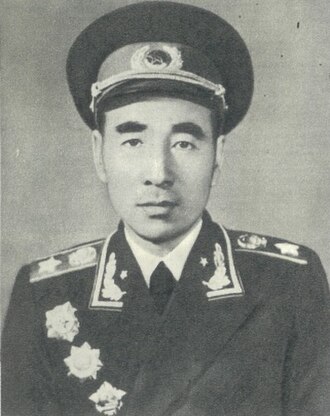 Lin Biao1907 – 1971Chinese Communist military commander and politicianSource: Wikidata (citizenship)
 Chiang Ching-kuo1910 – 19886th and 7th President of Republic of ChinaSource: Wikidata (citizenship)
 Lin Yutang1895 – 1976Chinese inventor, novelist and philosopher (1895–1976)Source: Wikidata (citizenship)
 Shunzhi Emperor1638 – 1661Qing Dynasty emperor of China (1638–1661)Source: Wikidata (citizenship)
 Zhu De1886 – 1976Marshal of the People's Republic of China (1886-1976)Source: Wikidata (citizenship)
 Hong Taiji1592 – 16431st emperor of the Qing Dynasty (1592-1643)Source: Wikidata (citizenship)
Everything that happened
- 16681668 Shandong earthquakeQing dynastyA major earthquake occurred during the rule of the Qing dynasty in Shandong Province on July 25, 1668. It had an estimated magnitude of Ms 8.5, making it the largest historical earthquake in East China, and one of the largest to occur on land. An estimated 43,000 to 50,000 people were killed, and its effects were widely felt.Source: Wikidata (country)
- 1688 – 1759Dzungar–Qing WarsMongolian SteppeThe Dzungar–Qing Wars (Mongolian: Зүүнгар-Чин улсын дайн, simplified Chinese: 准噶尔之役; traditional Chinese: 準噶爾之役; pinyin: Zhǔngá'ěr zhī Yì; lit. 'Dzungar Campaign'), also known as the Sino-Dzungar Wars, were a decades-long series of conflicts that pitted the Dzungar Khanate against the Qing dynasty and its Mongol vassals.Source: Wikidata (country of the location)
- 1788 – 1789Sino-Nepalese WarTibetThe Sino-Nepalese War was a war fought between the Qing dynasty of China and the Kingdom of Nepal in the late 18th century. It originated from a long-standing trade dispute over debased silver currency minted by Nepal for Tibet, in return for which Tibet started sending low-quality halite, leading to a Nepalese invasion of Tibet (then a Qing protectorate) in 1788.Source: Wikidata (country)
- 1794 – 1804White Lotus RebellionQing dynastyThe White Lotus Rebellion (Chinese: 川楚白蓮教起義; pinyin: Chuān chǔ bái lián jiào qǐ yì, 1794–1804) was a rebellion initiated by followers of the White Lotus movement during the Qing dynasty of China.Source: Wikidata (country)
- 1844Treaty of WanghiaWangxiaThe Treaty of Wanghia (also known as the Treaty of Wangxia; Treaty of peace, amity, and commerce, between the United States of America and the Chinese Empire); (Chinese: [中美]望廈條約 / [中美]望厦条约) was the first of the unequal treaties imposed by the United States on the Qing dynasty.Source: Wikidata (country)
- 1851 – 1864Taiping RebellionChina properThe Taiping Rebellion (1850–1864) was a civil war in late imperial China fought between the ruling Qing dynasty and the rebelling Taiping Heavenly Kingdom. It was the deadliest civil war in history and the second-deadliest conflict in history overall. Estimates of the war's death toll range from 20–30 million, around 5–10% of the total Chinese population at the time, to 73–100 million, around 25% of the population.Source: Wikidata (country)
- 1851Jintian UprisingSite of the Jintian UprisingThe Jintian Uprising was an armed revolt formally declared by Hong Xiuquan, founder and leader of the God Worshippers, on 11 January 1851 during the late Qing dynasty of China. The uprising was named after the rebel base in Jintian, a town in Guangxi within present-day Guiping. It marked the beginning of the Taiping Rebellion.Source: Wikidata (country)
- 1858Treaty of TientsinHaiguang TempleThe Treaty of Tientsin, also known as the Treaty of Tianjin, is a collective name for several unequal treaties signed at Tianjin (then romanized as Tientsin) in June 1858. The Qing dynasty, Russian Empire, Second French Empire, United Kingdom, and the United States were the parties involved.Source: Wikidata (country)
- 1860Convention of PekingBeijingThe Convention of Peking or First Convention of Peking is an agreement comprising three distinct unequal treaties concluded between the Qing dynasty of China and Great Britain, France, and the Russian Empire in 1860.Source: Wikidata (country)
- 1894Port Arthur massacreLüshunkou DistrictThe Port Arthur massacre (Chinese: 旅順大屠殺) took place during the First Sino-Japanese War from 21 November 1894 for three days, in the Chinese coastal city of Port Arthur (now Lüshunkou District of Dalian, Liaoning), when advance elements of the First Division of the Japanese Second Army under the command of General Yamaji Motoharu (1841–1897) killed somewhere between 2,600 civilians and 20,000 people including…Source: Wikidata (country)
- 1898Convention for the Extension of Hong Kong TerritoryQing dynastyThe Convention between the United Kingdom and China, Respecting an Extension of Hong Kong Territory, commonly known as the Convention for the Extension of Hong Kong Territory or the Second Convention of Peking, was a lease and unequal treaty signed between Qing China and the United Kingdom in Peking on 9 June 1898, leasing to the United Kingdom for 99 years, at no charge, the New Territories (as the area became…Source: Wikidata (country)
- 1898Convention for the Lease of the Liaotung PeninsulaBeijingThe Convention for the Lease of the Liaotung Peninsula (Chinese: 旅大租地條約; Russian: Русско-китайская конвенция), also known as the Pavlov Agreement, is an unequal treaty signed between Alexander Pavlov of the Russian Empire and Li Hongzhang of the Qing dynasty of China on 27 March 1898.Source: Wikidata (country)
- 1900Battle of PekingShuntian FuThe Battle of Peking (Chinese: 北京之戰), or historically the Relief of Peking (Chinese: 北京解圍戰), was the battle fought on 14–15 August 1900 in Beijing, in which the Eight-Nation Alliance relieved the siege of the Peking Legation Quarter during the Boxer Rebellion.Source: Wikidata (country)
- 1911Wuchang UprisingWuchang DistrictThe Wuchang Uprising was an armed rebellion against the ruling Qing dynasty that took place in Wuchang (now Wuchang District of Wuhan) in the Chinese province of Hubei on 10 October 1911, beginning the 1911 Revolution that successfully overthrew China's last imperial dynasty, the Qing dynasty. It was led by elements of the New Army, influenced by revolutionary ideas from Tongmenghui.Source: Wikidata (country)