Nazi Germany
11 events
Nazi Germany, officially the German Reich and later the Greater German Reich, was the German state between 1933 and 1945, when Adolf Hitler and the Nazi Party controlled the country, transforming it into a totalitarian dictatorship. The Third Reich, meaning "Third Realm" or "Third Empire", was the Nazi claim that Nazi Germany was the successor to the Holy Roman Empire (800–1806) and the German Empire (1871–1918); the Nazis called it the Thousand-Year Reich, but it ended just 12 years later in May 1945, when the Allies defeated Germany and entered Berlin, ending World War II in Europe.
Text from the Wikipedia article Nazi Germany, CC BY-SA 4.0
Built from Wikidata: an event or person is listed when Wikidata links them to this page, as shown next to each one. Many aren’t recorded there, so this list is incomplete.
Key people
 Adolf Hitler1889 – 1945Dictator of Germany from 1933 to 1945 (1889–1945)Source: Wikidata (citizenship)
 Marlene Dietrich1901 – 1992German and American actress and singer (1901–1992)Source: Wikidata (citizenship)
 Anne Frank1929 – 1945German-born Dutch Jewish diarist and Holocaust victim (1929–1945)Source: Wikidata (citizenship)
 David Hilbert1862 – 1943German mathematician (1862–1943)Source: Wikidata (citizenship)
 Erwin Schrödinger1887 – 1961Austrian physicist (1887–1961)Source: Wikidata (citizenship)
 Martin Heidegger1889 – 1976German philosopher (1889–1976)Source: Wikidata (citizenship)
 Joseph Goebbels1897 – 1945Nazi politician and Propaganda Minister (1897–1945)Source: Wikidata (citizenship)
 Helmut Kohl1930 – 2017Chancellor of West Germany and reunified Germany (1982–1998)Source: Wikidata (citizenship)
 Heinrich Himmler1900 – 1945German Nazi politician; leader of the German SS & main architect of the Holocaust (1900-1945)Source: Wikidata (citizenship)
 Erwin Rommel1891 – 1944German field marshal (1891–1944)Source: Wikidata (citizenship)
 Hermann Göring1893 – 1946German Nazi politician, military leader, and convicted war criminal (1893–1946)Source: Wikidata (citizenship)
 Wernher von Braun1912 – 1977German and later American aerospace engineer and space architect (1912–1977)Source: Wikidata (citizenship)
 Otto Hahn1879 – 1968German chemist and physicist (1879-1968)Source: Wikidata (citizenship)
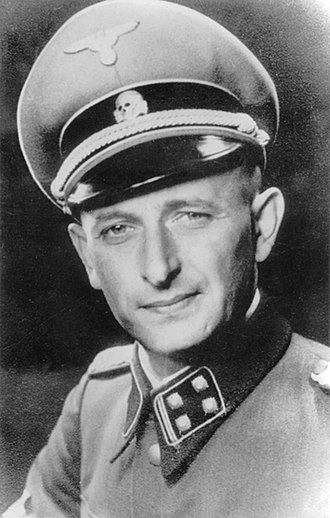 Adolf Eichmann1906 – 1962German-Austrian SS officer and one of the major organizers of the Holocaust (1906–1962)Source: Wikidata (citizenship)
 Leni Riefenstahl1902 – 2003German filmmaker, photographer, actress, and nazi propagandist (1902–2003)Source: Wikidata (citizenship)
 Kurt Waldheim1918 – 2007Austrian politician and diplomat (1918–2007)Source: Wikidata (citizenship)
 Walter Gropius1883 – 1969German-American architect (1883–1969)Source: Wikidata (citizenship)
 Oskar Schindler1908 – 1974German industrialist and Holocaust rescuer (1908–1974)Source: Wikidata (citizenship)
 Josef Mengele1911 – 1979Nazi SS doctor and Military Officer at Auschwitz (1911–1979)Source: Wikidata (citizenship)
 Herbert von Karajan1908 – 1989Austrian conductor (1908–1989)Source: Wikidata (citizenship)
 Ernst Ruska1906 – 1988German physicist (1906–1988)Source: Wikidata (citizenship)
 Martin Niemöller1892 – 1984German theologian (1892–1984)Source: Wikidata (citizenship)
 Alfred Rosenberg1893 – 1946Baltic German architect, Nazi politician and ideologue (1893-1946)Source: Wikidata (citizenship)
 Erich Ludendorff1865 – 1937German general and politician (1865–1937)Source: Wikidata (citizenship)
 Erich Kästner1899 – 1974German children's writer (1899–1974)Source: Wikidata (citizenship)
 Alphonse Mucha1860 – 1939Czech painter, illustrator and graphic artist (1860–1939)Source: Wikidata (citizenship)
 Alfred Jodl1890 – 1946German general and convicted war criminal (1890–1946)Source: Wikidata (citizenship)
 Friedrich Paulus1890 – 1957German general (1890–1957)Source: Wikidata (citizenship)
 Rudolf Carnap1891 – 1970German philosopher and logician (1891–1970)Source: Wikidata (citizenship)
 Richard Willstätter1872 – 1942German chemist (1872–1942)Source: Wikidata (citizenship)
 Otto Heinrich Warburg1883 – 1970German physiologist, medical doctor and Nobel laureate (1883–1970)Source: Wikidata (citizenship)
 Hans Fischer1881 – 1945German chemist (1881–1945)Source: Wikidata (citizenship)
 Ernst Thälmann1886 – 1944German communist politician, leader of Communist Party of Germany (1886–1944)Source: Wikidata (citizenship)
 Richard Kuhn1900 – 1967Austrian-German biochemist (1900-1967)Source: Wikidata (citizenship)
 Karlheinz Stockhausen1928 – 2007German composer (1928–2007)Source: Wikidata (citizenship)
 Ernst Cassirer1874 – 1945German philosopher (1874–1945)Source: Wikidata (citizenship)
 Arthur Seyss-Inquart1892 – 1946Austrian Nazi politician, and Nazi ruler of occupied Netherlands, convicted of crimes against humanity and sentenced to death (1892–1946)Source: Wikidata (citizenship)
 Günter Blobel1936 – 2018German American biologist (1999 Nobel Prize)Source: Wikidata (citizenship)
 Klaus Mann1906 – 1949German writer (1906–1949)Source: Wikidata (citizenship)
 Ernst Kaltenbrunner1903 – 1946Austrian SS official, a major perpetrator of the Holocaust and convicted war criminal (1903-1946)Source: Wikidata (citizenship)
 Heinrich Otto Wieland1877 – 1957German Nobel laureate in Chemistry (1877-1957)Source: Wikidata (citizenship)
 Hans Geiger1882 – 1945German physicist (1882–1945)Source: Wikidata (citizenship)
 Erwin Neherb. 1944German biophysicistSource: Wikidata (citizenship)
 Gerhard Herzberg1904 – 1999German-Canadian physicist and physical chemist (1904-1999)Source: Wikidata (citizenship)
 Leszek Kołakowski1927 – 2009Philosopher, historian of ideas (1927–2009)Source: Wikidata (citizenship)
 Albert Kesselring1885 – 1960German Luftwaffe Generalfeldmarschall during World War II (1885–1960)Source: Wikidata (citizenship)
 Magda Goebbels1901 – 1945German politician (1901–1945)Source: Wikidata (citizenship)
 Lutz Graf Schwerin von Krosigk1887 – 1977German nobleman, jurist, and senior Nazi government official (1887–1977)Source: Wikidata (citizenship)
Showing the 48 best-known of 49 people.
Everything that happened
- 1933Nazi book burningsBebelplatzThe Nazi book burnings were a campaign conducted by the German Student Union (German: Deutsche Studentenschaft, DSt) to ceremonially burn books in Nazi Germany and Austria in the 1930s. The books targeted for burning were those viewed as being subversive or as representing ideologies opposed to Nazism.Source: Wikidata (country)
- 1936Anti-Comintern PactBerlinThe Anti-Comintern Pact, officially the Agreement against the Communist International, was an anti-communist pact concluded between Nazi Germany and the Empire of Japan on 25 November 1936 and directed against the Communist International (Comintern). It was signed by the German ambassador-at-large Joachim von Ribbentrop and the Japanese ambassador to Germany Kintomo Mushanokōji.Source: Wikidata (country)
- 1939 – 1940Operation TannenbergGeneral GovernmentOperation Tannenberg (German: Unternehmen Tannenberg, Polish: Operacja Tannenberg) was one of the first anti-Polish extermination actions by Nazi Germany in German-occupied Poland from September 1939 to January 1940.Source: Wikidata (country of the location)
- 1940 – 1945Auschwitz concentration campPolandAuschwitz (German: [ˈaʊ̯ʃvɪts]), also known as Oświęcim (Polish: [ɔˈɕfjɛɲ.t͡ɕim]), was a complex of over 40 concentration and extermination camps operated by Nazi Germany in occupied Poland (in a portion annexed into Germany in 1939) during World War II and the Holocaust.Source: Wikidata (country)
- 1941Operation BarbarossaEstoniaOperation Barbarossa was the invasion of the Soviet Union by Nazi Germany and several of its European Axis allies starting on Sunday, 22 June 1941, during World War II. More than 3.8 million Axis troops invaded the western Soviet Union along a 2,900-kilometer (1,800 mi) front, with the main goal of capturing territory up to a line between Arkhangelsk and Astrakhan, known as the A–A line.Source: Wikidata (country of the location)
- 1943Kerch–Eltigen operationKerch PeninsulaThe Kerch–Eltigen operation was a World War II amphibious offensive made in November 1943 by the Red Army as a precursor to the Crimean offensive (8 April-12 May 1944), with the object of defeating and forcing the withdrawal of the German forces from the Crimea.Source: Wikidata (country)
- 1943Operation Harvest FestivalLublin-Majdanek concentration campOperation Harvest Festival (German: Aktion Erntefest) was the murder of up to 43,000 Jews at the Majdanek, Poniatowa and Trawniki concentration camps by the SS, the Order Police battalions, and the Ukrainian Sonderdienst on 3–4 November 1943.Source: Wikidata (country)
- 1943Rosenstrasse protestGermanyThe Rosenstrasse protest was the only mass public demonstration by Germans in the Third Reich against the deportation of Jews. The protest on Rosenstraße ("Roses street") took place in Berlin during February and March 1943.Source: Wikidata (country)
- 1944Operation OverlordNormandyOperation Overlord was the codename for the Battle of Normandy, the Allied operation that launched the successful invasion of German-occupied Western Europe during World War II. The operation was launched on 6 June 1944 (D-Day) with the Normandy landings (Operation Neptune). A 1,200-plane airborne assault preceded an amphibious assault involving more than 5,000 vessels.Source: Wikidata (country)
- 1944Nemmersdorf massacreMayakovskoyeThe Nemmersdorf massacre was a civilian massacre perpetrated by Red Army soldiers in the late stages of World War II. Nemmersdorf (present-day Mayakovskoye, Kaliningrad Oblast) was one of the first prewar ethnic German settlements to fall to the advancing Red Army during the war. On 21 October 1944, Soviet soldiers killed many German civilians as well as French and Belgian POWs.Source: Wikidata (country)
- 1945Dachau liberation reprisalsDachau concentration campDuring the Dachau liberation reprisals, German SS troops were killed by outraged U.S. soldiers and concentration camp prisoners at the Dachau concentration camp on April 29, 1945, during World War II. It is unclear how many SS guards were killed in the incident, but most estimates place the number killed at around 35 to 50.Source: Wikidata (country of the location)