Country · 1466 – today
Mexico
47 events
Mexico, officially the United Mexican States, is a country in North America. It is the northernmost country in Latin America, bordering the United States of America to the north and Guatemala and Belize to the southeast, while having maritime boundaries with the Pacific Ocean to the west, the Caribbean Sea to the southeast, and the Gulf of Mexico to the east. Mexico covers 1,972,550 km2 (761,610 sq mi), and is the thirteenth-largest country in the world by land area.
Text from the Wikipedia article Mexico, CC BY-SA 4.0
Built from Wikidata: an event or person is listed when Wikidata links them to this page, as shown next to each one. Many aren’t recorded there, so this list is incomplete.
Showing 644 years
Key people
 Frida Kahlo1907 – 1954Mexican painter (1907–1954)Source: Wikidata (citizenship)
 Leon Trotsky1879 – 1940Russian Marxist revolutionary (1879–1940)Source: Wikidata (citizenship)
 Hernán Cortés1485 – 1547Spanish conquistadorSource: Wikidata (citizenship)
 Octavio Paz1914 – 1998Mexican writer, poet an diplomat (1914–1998)Source: Wikidata (citizenship)
 Lila Downsb. 1968Mexican-American singer-songwriterSource: Wikidata (citizenship)
 Salma Hayekb. 1966Mexican and American actress (born 1966)Source: Wikidata (citizenship)
 Claudia Sheinbaumb. 1962President of Mexico since 2024Source: Wikidata (citizenship)
 José Martí1853 – 1895Cuban poet, philosopher and nationalist (1853-1895)Source: Wikidata (citizenship)
 Luis Buñuel1900 – 1983Spanish-Mexican filmmaker (1900–1983)Source: Wikidata (citizenship)
 Julio Cortázar1914 – 1984Argentine writer and translator (1914–1984)Source: Wikidata (citizenship)
 Andrés Manuel López Obradorb. 1953Mexican politician. President of Mexico from 2018 to 2024Source: Wikidata (citizenship)
 Benito Juárez1806 – 1872President of Mexico from 1858 to 1872Source: Wikidata (citizenship)
 Diego Rivera1886 – 1957Mexican muralist (1886–1957)Source: Wikidata (citizenship)
 Enrique Peña Nietob. 196664th President of MexicoSource: Wikidata (citizenship)
 Anthony Quinn1915 – 2001Mexican and American actor (1915–2001)Source: Wikidata (citizenship)
 Porfirio Díaz1830 – 1915President of Mexico (1830–1915)Source: Wikidata (citizenship)
 Carlos Fuentes1928 – 2012Mexican writer (1928–2012)Source: Wikidata (citizenship)
 Camila Cabellob. 1997Cuban-Mexican-American singerSource: Wikidata (citizenship)
 Carlos Slimb. 1940Mexican business magnate and investorSource: Wikidata (citizenship)
 Pancho Villa1878 – 1923Mexican revolutionary (1878-1923)Source: Wikidata (citizenship)
 Guillermo del Torob. 1964Mexican filmmaker and author (born 1964)Source: Wikidata (citizenship)
 Carlos Santanab. 1947American guitaristSource: Wikidata (citizenship)
 Sor Juana Inés de la Cruz1651 – 1695Mexican writer, philosopher, playwright and poetSource: Wikidata (citizenship)
 Felipe Calderónb. 196263th President of MexicoSource: Wikidata (citizenship)
 Alejandro González Iñárritub. 1963Mexican film directorSource: Wikidata (citizenship)
 Mario Molina1943 – 2020Mexican chemical engineer (1943–2020)Source: Wikidata (citizenship)
 Alfonso Cuarónb. 1961Mexican filmmaker (born 1961)Source: Wikidata (citizenship)
 Javier Hernándezb. 1988Mexican association football player (b. 1988)Source: Wikidata (citizenship)
 Vicente Foxb. 194262th president of MexicoSource: Wikidata (citizenship)
 Moctezuma II1466 – 15209th tlatoani of Tenochtitlan and ruler of the Aztec Triple Alliance (1466-1520)Source: Wikidata (country of birthplace)
 Thalíab. 1971Mexican singer and actress (born 1971)Source: Wikidata (citizenship)
 Antonio López de Santa Anna1794 – 1876Mexican politician and military leader (1794-1876)Source: Wikidata (citizenship)
 Francisco I. Madero1873 – 1913Mexican revolutionary leader and president (1873-1913)Source: Wikidata (citizenship)
- Dhariusb. 1984Mexican rapperSource: Wikidata (citizenship)
 Fermín IVb. 1974Mexican rapper and pastorSource: Wikidata (citizenship)
 Guillermo Ochoab. 1985Mexican association football player (born 1985)Source: Wikidata (citizenship)
 Rafael Márquez El piojob. 1979Mexican association football playerSource: Wikidata (citizenship)
 Miguel Hidalgo Y Costilla1753 – 1811Catholic priest, leader of the Mexican War of IndependenceSource: Wikidata (country of birthplace)
 Gael García Bernalb. 1978Mexican actor and producerSource: Wikidata (citizenship)
 Juan Rulfo1917 – 1986Mexican writer (1917–1986)Source: Wikidata (citizenship)
 Carlos Velab. 1989Mexican footballer (born 2024)Source: Wikidata (citizenship)
 Lázaro Cárdenas1895 – 197051st President of MexicoSource: Wikidata (citizenship)
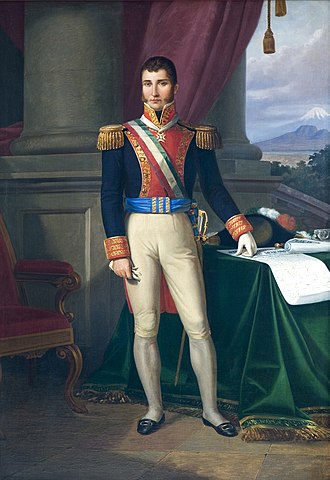 Agustín I of Mexico1783 – 1824First constitutional emperor of Mexico (1783-1824)Source: Wikidata (citizenship)
 Alfonso García Robles1911 – 1991Mexican diplomat and politician (1911-1991)Source: Wikidata (citizenship)
 David Alfaro Siqueiros1896 – 1974Mexican painter and muralist (1908–1974)Source: Wikidata (citizenship)
 Giovani dos Santosb. 1989Mexican association football playerSource: Wikidata (citizenship)
 Louis C.K.b. 1967American comedian, actor, and filmmaker (born 1967)Source: Wikidata (citizenship)
 Álvaro Obregón1880 – 1928Mexican politician, president of MexicoSource: Wikidata (citizenship)
Showing the 48 best-known of 62 people.
Everything that happened
- 1492Columbus reaches the AmericasCaribbeanChristopher Columbus lands in the Bahamas, beginning lasting contact between Europe and the Americas.Source: Wikidata (country of the location)
- 1520Battle of OtumbaOtompanThe Battle of Otumba was a major battle fought on 7 July 1520 between the Aztec Empire and its allies led by the Cihuacoatl Matlatzincátzin, and Spanish conquistadors under Hernán Cortés, alongside support from the Confederacy of Tlaxcala. The battle was fought on the plain of Temalcatitlán, near modern-day Otumba during the conquest of the Aztec Empire by Spain.Source: Wikidata (country)
- 1520La Noche TristeLake TexcocoLa Noche Triste ("The Night of Sorrows", literally "The Sad Night"), officially called in Mexico Victorious Night, was an important event during the Spanish conquest of the Aztec Empire, where Hernán Cortés and his army of Spanish conquistadors, including their native allies were driven out of the Mexica capital, Tenochtitlan.Source: Wikidata (country)
- 1520Massacre in the Great Temple of TenochtitlanTemplo MayorThe Massacre in the Great Temple, also called the Toxcatl Massacre, or the Alvarado Massacre, was an event on 22 May 1520, in the Mexica, also known as the Aztec, capital of Tenochtitlan during the Spanish conquest of the Aztec Empire, in which the celebration of the Feast of Toxcatl ended in a massacre of Mexica elites.Source: Wikidata (country)
- 1521Fall of TenochtitlanTenochtitlanThe fall of Tenochtitlan, the capital of the Mexica, was an important event in the Spanish conquest of the Mexica. It occurred in 1521 following extensive negotiations between local factions and Spanish conquistador Hernán Cortés. He was aided by La Malinche, his interpreter and companion, and by thousands of indigenous allies, especially Tlaxcaltec warriors.Source: Wikidata (country)
- 1796 – 1808Anglo-Spanish WarEnglish ChannelThe Anglo-Spanish War was fought between 1796 and 1802, and again from 1804 to 1808, as part of the First Coalition Wars. The war ended when an unexpected alliance was formed between Great Britain and the Spanish Bourbon dynasty, resulting in the French invasion.Source: Wikidata (country of the location)
- 1798 – 1802War of the Second CoalitionItalian PeninsulaThe War of the Second Coalition (French: Guerre de la Deuxième Coalition) (1798–1802) was the second war between revolutionary France and a coalition of European monarchies, led by Britain, Austria and Russia, and including the Ottoman Empire, Portugal, Naples and various German monarchies. Prussia did not join the coalition, while Spain supported France.Source: Wikidata (country of the location)
- 1810Grito de DoloresDolores Hidalgo MunicipalityThe Cry of Dolores (Spanish: Grito de Dolores) occurred in Dolores, Mexico, on 16 September 1810, when Roman Catholic priest Miguel Hidalgo y Costilla rang his church bell and gave the call to arms that triggered the Mexican War of Independence. The Cry of Dolores is most commonly known by the locals as El Grito de Independencia (The Independence Cry).Source: Wikidata (country)
- 1846 – 1848Mexican–American WarMexicoThe Mexican–American War, also known in the United States as the Mexican War and in Mexico as the United States intervention in Mexico, (April 25, 1846 – February 2, 1848) was an invasion of Mexico by the United States.Source: Wikidata (country of the location)
- 1846Battle of MonterreyMonterreyIn the Battle of Monterrey (September 21–24, 1846) during the Mexican–American War, General Pedro de Ampudia and the Mexican Army of the North was defeated by the Army of Occupation, a force of United States Regulars, Volunteers, and Texas Rangers under the command of General Zachary Taylor.Source: Wikidata (country)
- 1847Battle of Buena VistaMexicoThe Battle of Buena Vista (February 22–23, 1847), known as the Battle of La Angostura in Mexico, and sometimes as Battle of Buena Vista/La Angostura, was a battle of the Mexican–American War. It was fought between U.S. forces, largely volunteers, under General Zachary Taylor, and the much larger Mexican Army under General Antonio López de Santa Anna.Source: Wikidata (country)
- 1847Battle of ChapultepecReal Valle de CamargoThe Battle of Chapultepec took place between U.S. troops and Mexican forces holding the strategically located Chapultepec Castle on the outskirts of Mexico City on September 13, 1847 during the Mexican–American War. The castle was built atop a 200-foot (61 m) hill in 1783, and in 1833 it was converted into a military academy and a gunpowder storage facility. The hill was surrounded by a wall 1,600 yards long.Source: Wikidata (country)
- 1847Battle of ChurubuscoMexico CityThe Battle of Churubusco took place on August 20, 1847, while Santa Anna's army was in retreat from the Battle of Contreras during the Mexican–American War. It was the battle where the San Patricio Battalion, made up largely of US deserters, made their last stand against U.S. forces. The U.S. Army was victorious, outnumbering more than six-to-one the defending Mexican troops. After the battle, the U.S.Source: Wikidata (country)
- 1847 – 1901Caste War of YucatánYucatan PeninsulaThe Caste War of Yucatán or ba'atabil kichkelem Yúum (1847–1915) began with the revolt of Indigenous Maya people of the Yucatán Peninsula against Hispanic populations, called Yucatecos. The latter had held political and economic control of the region after the Spanish conquest of Yucatán and subjugation of the Maya people in the late 16th century. It was one of the most successful modern Native American revolts.Source: Wikidata (country of the location)
- 1847Siege of VeracruzVeracruzOn 9 March 1847, during the Mexican–American War, the United States military made an amphibious landing and besieged the key Mexican seaport of Veracruz. The port surrendered twenty days later. The U.S. forces then marched inland to Mexico City.Source: Wikidata (country)
- 1853Gadsden PurchaseUnited StatesThe Gadsden Purchase (Spanish: Venta de La Mesilla, lit. 'La Mesilla sale'), also known as the Treaty of Mesilla, is the acquisition of a 29,640-square-mile (76,800 km2) region of present-day southern Arizona and southwestern New Mexico by the United States from Mexico. The first draft was signed on December 31, 1853, by James Gadsden, US Minister to Mexico, and by Antonio López de Santa Anna, president of Mexico.Source: Wikidata (country)
- 1862Battle of PueblaHeroica Puebla de ZaragozaThe Battle of Puebla (Spanish: Batalla de Puebla; French: Bataille de Puebla), also known as the Battle of the Fifth of May (Spanish: Batalla del Cinco de Mayo) took place on 5 May 1862, near Puebla de los Ángeles, during the second French intervention in Mexico.Source: Wikidata (country)
- 1863Battle of CamarónCamarón de TejedaThe Battle of Camarón (French: Bataille de Camerone) was a last stand engagement fought on 30 April 1863 between the French Foreign Legion and the Mexican Army, during the Second French intervention in Mexico (1861–1867).Source: Wikidata (country)
- 1898Spanish–American WarCaribbean SeaThe Spanish–American War (April 21 – August 13, 1898) was fought between Spain and the United States in 1898. It began with the sinking of the USS Maine in Havana Harbor in Cuba, and resulted in the U.S. acquiring sovereignty over Puerto Rico, Guam, and the Philippines, and establishing a protectorate over Cuba. It represented U.S.Source: Wikidata (country of the location)
- 1910 – 1920Mexican RevolutionMexicoThe Mexican Revolution (Spanish: Revolución mexicana) was an extended sequence of armed regional conflicts in Mexico from 20 November 1910 to 1 December 1920. It has been called "the defining event of modern Mexican history". It saw the destruction of the Federal Army, its replacement by a revolutionary army, and the transformation of Mexican culture and government.Source: Wikidata (country)
- 1910 – 1919Mexican Border WarMexico–United States borderThe Mexican Border War was a series of military engagements between the United States military and several Mexican factions in the Mexican–American border region of North America during the Mexican Revolution.Source: Wikidata (country of the location)
- 1913Ten Tragic DaysMexico CityThe Ten Tragic Days (Spanish: La Decena Trágica) is the name given to the multi-day coup d'état during the Mexican Revolution in Mexico City. It was staged by opponents of Francisco I. Madero, the democratically elected president of Mexico, between 9–19 February 1913. The coup instigated a second phase of the Mexican Revolution, after dictator Porfirio Díaz had been ousted and replaced in elections by Francisco I.Source: Wikidata (country)
- 1917Pancho Villa ExpeditionChihuahuaThe Pancho Villa Expedition, now known officially in the United States as the Mexican Expedition but originally referred to as the "Punitive Expedition, US Army," was a military operation conducted by the United States Army against the paramilitary forces of Mexican revolutionary Francisco "Pancho" Villa from March 14, 1916, to February 7, 1917, during the Mexican Revolution of 1910–1920.Source: Wikidata (country)
- 1926 – 1929Cristero WarMexicoThe Cristero War (Spanish: La guerra cristera), also known as the Cristero Rebellion or La Cristiada [la kɾisˈtjaða], was a widespread struggle in central and western Mexico from 3 August 1926 to 21 June 1929 in response to the implementation of secularist and anticlerical articles of the 1917 Constitution.Source: Wikidata (country)
- 1939 – 1945Battle of the AtlanticAtlantic OceanThe Battle of the Atlantic, the longest continuous military campaign in World War II, ran from 1939 to the defeat of Nazi Germany in 1945, covering a major part of the naval history of World War II. At its core was the Allied naval blockade of Germany, announced the day after the declaration of war, and Germany's subsequent counterblockade. The campaign peaked from mid-1940 to the end of 1943.Source: Wikidata (country of the location)
- 1962Cuban Missile CrisisCubaThe Cuban Missile Crisis, also known as the October Crisis in Cuba (Spanish: Crisis de Octubre), or the Caribbean Crisis (Russian: Карибский кризис, romanized: Karibskiy krizis), was a 13-day confrontation between the governments of the United States and the Soviet Union, when American deployments of nuclear missiles in the United Kingdom, Italy and Turkey were matched by Soviet deployments of nuclear missiles in…Source: Wikidata (country of the location)
- 1968Tlatelolco massacrePlaza de las Tres CulturasThe Tlatelolco massacre (Spanish: Masacre de Tlatelolco) was a military massacre committed by the Mexican Armed Forces against the students of the National Autonomous University of Mexico (UNAM), the National Polytechnic Institute (IPN) and other universities in Mexico.Source: Wikidata (country)
- 1968Treaty of TlatelolcoTlatelolcoThe Treaty for the Prohibition of Nuclear Weapons in Latin America and the Caribbean (commonly known as the Treaty of Tlatelolco) is an international treaty that establishes the nuclear disarmament of Latin America and the Caribbean.Source: Wikidata (country of the location)
- 1970Brazil wins a third World CupMexicoPelé’s Brazil win in Mexico, become the first team to lift the trophy three times and keep the original Jules Rimet trophy. It is also the first World Cup broadcast in color.Source: Wikidata (country)
- 19851985 Mexico City earthquakeMexico CityThe 1985 Mexico City earthquake struck in the early morning of 19 September at 07:17:50 (CST) with a moment magnitude of 8.0 and a maximal Mercalli intensity of IX (Violent). The event caused serious damage to the Greater Mexico City area and the deaths of at least 5,000 people.Source: Wikidata (country)
- 1986Maradona’s World CupMexicoDiego Maradona leads Argentina to the title. His two goals against England, the “Hand of God” and a solo run past five players, become legend.Source: Wikidata (country)
- 19921992 Guadalajara explosionsGuadalajaraA series of ten explosions took place on April 22, 1992, in the downtown district of Analco Colonia Atlas in Guadalajara city, Jalisco state, Mexico. Numerous gasoline explosions in the sewer system and fires over four hours destroyed 8 kilometres (5.0 mi) of streets. Gante Street was the most damaged.Source: Wikidata (country)
- 1993Femicide in Ciudad JuárezCiudad JuárezMore than 500 women were killed between 1993 and 2011 in Ciudad Juárez, a city in northern Mexico. The murders of women and girls received international attention primarily due to perceived government inaction in preventing the violence and bringing perpetrators to justice.Source: Wikidata (country)
- 1994Chiapas conflictChiapasThe Chiapas conflict (Spanish: Conflicto de Chiapas) consisted of the 1994 Zapatista uprising, the 1995 Zapatista crisis, and the subsequent tension between the Mexican state, the Indigenous peoples and subsistence farmers of Chiapas from 1994 to 2020.Source: Wikidata (country of the location)
- 2006Anti-Counterfeiting Trade AgreementTokyoThe Anti-Counterfeiting Trade Agreement (ACTA) is a multilateral treaty for the purpose of establishing international standards for intellectual property rights enforcement that did not enter into force.Source: Wikidata (country of the location)
- 20102010 Baja California earthquakeMexicoThe 2010 Baja California earthquake (also known as 2010 Easter earthquake, 2010 Sierra El Mayor earthquake, or 2010 El Mayor–Cucapah earthquake) occurred on April 4 (Easter Sunday) with a moment magnitude of 7.2 and a maximum Mercalli intensity of IX (Violent). The shock originated at 15:40:41 local time (3:40:41 PM PDT) south of Guadalupe Victoria, Baja California, Mexico.Source: Wikidata (country)
- 20122012 Guerrero–Oaxaca earthquakeMexicoThe 2012 Guerrero–Oaxaca earthquake struck southern Mexico with a moment magnitude of 7.4 at 12:02 local time on Tuesday, 20 March. Its epicenter was near Ometepec, in the border between the states of Guerrero and Oaxaca. With a shallow focus of 20 km, the earthquake caused strong shaking over a large area along the Oaxaca–Guerrero border and the adjacent Pacific coastline.Source: Wikidata (country)
- 2015Ni una menosArgentinaNi una menos (Spanish: [ni ˈuna ˈmenos]; Spanish for "Not one [woman] less") is a Hispanic American fourth-wave grassroots feminist movement, which started in Argentina and has spread across several Hispanic American countries, that campaigns against gender-based violence. This mass mobilization comes as a response to various systemic issues that proliferate violence against women.Source: Wikidata (country of the location)
- 20172017 Chiapas earthquakeChiapasThe 2017 Chiapas earthquake struck at 23:49 CDT on 7 September (local time; 04:49 on the 8th UTC) in the Gulf of Tehuantepec off the southern coast of Mexico near the state of Chiapas, approximately 87 kilometres (54 mi) southwest of Pijijiapan (alternately, 101 kilometres (63 mi) south-southwest of Tres Picos), with a Mercalli intensity of IX (Violent). The moment magnitude was estimated to be Mw 8.2.Source: Wikidata (country)
- 20172017 Puebla earthquakeMexicoThe 2017 Puebla earthquake, also known as 19S, struck at 13:14 CDT (18:14 UTC) on 19 September 2017 with an estimated magnitude of 7.1 Mw and strong shaking for about 20 seconds. Its epicenter was about 55 km (34 mi) south of the city of Puebla, Mexico. The earthquake caused damage in the Mexican states of Puebla and Morelos and in the Greater Mexico City area, including the collapse of more than 40 buildings.Source: Wikidata (country)
- 20182018 Oaxaca earthquakeMexicoThe 2018 Oaxaca earthquake occurred on February 16, 2018, at 17:39 local time (23:39 UTC) in the Sierra Madre del Sur mountains in Oaxaca state in Southern Mexico. It had a magnitude of 7.2 on the moment magnitude scale and a maximum felt intensity of VII (Very strong) on the Mercalli intensity scale. The hypocenter was located at a depth of 24.6 km and approximately 37 km northeast of Pinotepa de Don Luis.Source: Wikidata (country)
- 2018Central American migrant caravansMexicoCentral American migrant caravans, also known as the Viacrucis del migrante ("Migrant's Way of the Cross"), are migrant caravans that travel from Central America to the Mexico–United States border to seek asylum in the United States.Source: Wikidata (country)
- 2020COVID-19 pandemicWorldwideA new coronavirus spreads worldwide. Lockdowns, remote work and fast-developed vaccines reshape daily life.Source: Wikidata (country)
- 20202020 Oaxaca earthquakeMexicoAn earthquake struck the Mexican state of Oaxaca at 10:29 local time on June 23, 2020, with a magnitude of 7.4 Mw. The epicenter was 19 miles (31 km) from San Miguel del Puerto and 7.5 miles (12.1 km) south-southwest of Santa María Zapotitlán. The quake was felt by an estimated 49 million people in Mexico and Guatemala, with some tremors felt as far away as 640 kilometers (400 mi).Source: Wikidata (country)
- 2025United States military buildup in the Caribbean during Operation Southern SpearCaribbean SeaIn late August 2025, the United States began a naval buildup in the southern Caribbean with the stated goal of combating drug trafficking. US president Donald Trump directed the United States Armed Forces to begin using military force against certain Latin American drug cartels, characterizing the smugglers as narcoterrorists.Source: Wikidata (country of the location)
- 20262026 Jalisco operationTapalpaOn 22 February 2026, the Mexican Armed Forces conducted an operation which killed El Mencho, the leader of the Jalisco New Generation Cartel (CJNG), and six others in Tapalpa, Jalisco, Mexico. The operation sparked clashes in the area, resulting in shootouts, explosions and multiple vehicles and stores being set on fire throughout the state and much of the rest of the country.Source: Wikidata (country)
- 2026First 48-team World CupUSA, Canada and MexicoThe tournament grows to 48 teams and 104 matches, spread across three host countries for the first time.Source: Wikidata (country)