Kingdom of Prussia
3 events
The Kingdom of Prussia (German: Königreich Preußen, pronounced [ˈkøːnɪkʁaɪç ˈpʁɔʏsn̩] ) was a German state that existed from 1701 to 1918. It played a significant role in the unification of Germany in 1871 and was a major constituent of the German Empire until its dissolution in 1918. The Kingdom of Prussia took its name from the historical region of Prussia, and controlled most of said region, although it was based in the Margraviate of Brandenburg, and its capital was Berlin.
Text from the Wikipedia article Kingdom of Prussia, CC BY-SA 4.0
Built from Wikidata: an event or person is listed when Wikidata links them to this page, as shown next to each one. Many aren’t recorded there, so this list is incomplete.
Key people
 Karl Marx1818 – 1883German-born philosopher (1818–1883)Source: Wikidata (citizenship)
 Friedrich Nietzsche1844 – 1900German philosopher (1844-1900)Source: Wikidata (citizenship)
 Immanuel Kant1724 – 1804German philosopher (1724-1804)Source: Wikidata (citizenship)
 Otto von Bismarck1815 – 1898German statesman and Chancellor (1815-1898)Source: Wikidata (citizenship)
 Friedrich Engels1820 – 1895German philosopher, sociologist and economist (1820–1895)Source: Wikidata (citizenship)
 Leonhard Euler1707 – 1783Swiss mathematician, physicist, and engineer (1707–1783)Source: Wikidata (citizenship)
 Arthur Schopenhauer1788 – 1860German philosopher (1788-1860)Source: Wikidata (citizenship)
 Max Weber1864 – 1920German sociologist, philosopher, and political economist (1864–1920)Source: Wikidata (citizenship)
 Heinrich Heine1797 – 1856German poet, writer and literary critic (1797–1856)Source: Wikidata (citizenship)
 David Hilbert1862 – 1943German mathematician (1862–1943)Source: Wikidata (citizenship)
 Wilhelm Röntgen1845 – 1923German physicist (1845–1923)Source: Wikidata (citizenship)
 Catherine II of Russia1729 – 1796Eighth Emperor of Russia, called the Great, r. 1762–1796 (lived 1729-1796)Source: Wikidata (citizenship)
 Konrad Adenauer1876 – 1967German politician, Chancellor of West Germany (1949–1963), Zentrum and CDUSource: Wikidata (citizenship)
 Alexander von Humboldt1769 – 1859Prussian geographer, naturalist and explorer (1769–1859)Source: Wikidata (citizenship)
 Wilhelm II1859 – 1941As King of Prussia last German Emperor from 1888 to 1918 (1859–1941)Source: Wikidata (citizenship)
 Theodor Mommsen1817 – 1903German classical scholar and historian (1817–1903)Source: Wikidata (citizenship)
 Frederick II of Prussia1712 – 1786King of Prussia from 1740 to 1786 (1712-1786)Source: Wikidata (citizenship)
 Gerhart Hauptmann1862 – 1946German dramatist who received the Nobel Prize in Literature in 1912 (1862-1946)Source: Wikidata (citizenship)
 Paul von Hindenburg1847 – 1934Prussian-German field marshal of the German Empire, statesman and president of Weimar Germany and Nazi Germany (1847–1934)Source: Wikidata (citizenship)
 Carl von Clausewitz1780 – 1831German-Prussian general and military theorist (1780–1831)Source: Wikidata (citizenship)
 Ernst Haeckel1834 – 1919German zoologist (1834-1919)Source: Wikidata (citizenship)
 Jacques Offenbach1819 – 1880German-born French composer (1819–1880)Source: Wikidata (citizenship)
 Paul Heyse1830 – 1914German writer (1830–1914)Source: Wikidata (citizenship)
 Johann Gottfried Herder1744 – 1803German philosopher, theologian, poet (1744–1803)Source: Wikidata (citizenship)
 Rudolf Christoph Eucken1846 – 1926(1846-1926) German philosopherSource: Wikidata (citizenship)
 Walter Benjamin1892 – 1940German cultural critic, philosopher and social critic (1892–1940)Source: Wikidata (citizenship)
 Wilhelm von Humboldt1767 – 1835Prussian philosopher, government official, diplomat, and educator (1767–1835)Source: Wikidata (citizenship)
 Paul Klee1879 – 1940German-Swiss artist (1879–1940)Source: Wikidata (citizenship)
 Karl Ferdinand Braun1850 – 1918German physicist (1850–1918)Source: Wikidata (citizenship)
 Fritz Haber1868 – 1934German chemist and receiver of the Nobel prize (1868–1934)Source: Wikidata (citizenship)
 Gustav Kirchhoff1824 – 1887German physicist (1824–1887)Source: Wikidata (citizenship)
 E. T. A. Hoffmann1776 – 1822German writer (1776-1822)Source: Wikidata (citizenship)
 Wilhelm I1797 – 188819th-century German Emperor and King of Prussia (1797–1888)Source: Wikidata (citizenship)
 Max Stirner1806 – 1856German philosopher (1806–1856)Source: Wikidata (citizenship)
 Caspar David Friedrich1774 – 1840German Romantic landscape painter (1774–1840)Source: Wikidata (citizenship)
 Emil von Behring1854 – 1917German physiologist who received the first Nobel Prize in Physiology or Medicine 1901 for his discovery of a diphtheria antitoxinSource: Wikidata (citizenship)
 Heinrich von Kleist1777 – 1811German poet, dramatist, novelist and short story writer (1777–1811)Source: Wikidata (citizenship)
 Paul Ehrlich1854 – 1915Jewish-German physician and scientist (1854-1915)Source: Wikidata (citizenship)
 Karl Weierstraß1815 – 1897German mathematician (1815–1897)Source: Wikidata (citizenship)
 Hermann von Helmholtz1821 – 1894German physicist and physiologist (1821-1894)Source: Wikidata (citizenship)
 Walther Hermann Nernst1864 – 1941German physical chemist and physicist (1864–1941)Source: Wikidata (citizenship)
 Jacob Grimm1785 – 1863German philologist, linguist, jurist and mythologist (1785–1863)Source: Wikidata (citizenship)
 Robert Bunsen1811 – 1899German chemist (1811-1899)Source: Wikidata (citizenship)
 Rudolf Clausius1822 – 1888German mathematical physicist and professor (1822–1888)Source: Wikidata (citizenship)
 Rudolf Virchow1821 – 1902German doctor, anthropologist, public health activist, pathologist, prehistorian, biologist and politician (1821-1902)Source: Wikidata (citizenship)
 Theodor Fontane1819 – 1898German novelist and poet (1819–1898)Source: Wikidata (citizenship)
 Hermann Minkowski1864 – 1909German mathematician and physicist (1864–1909)Source: Wikidata (citizenship)
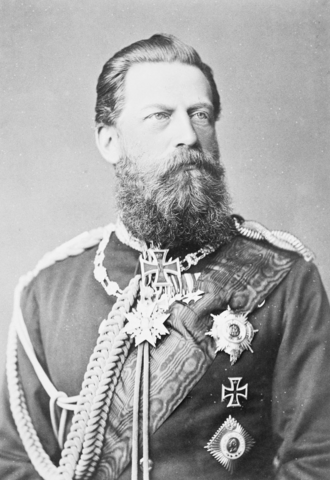 Frederick III, German Emperor1831 – 1888As King of Prussia German Emperor (1831–1888)Source: Wikidata (citizenship)
Showing the 48 best-known of 108 people.
Everything that happened
- 1807Battle of EylauKaliningradThe Battle of Eylau (also known as the Battle of Preussisch-Eylau) was a bloody and strategically inconclusive battle on 7 and 8 February [O.S. 26 and 27 Jan.] 1807 between Napoleon's Grande Armée and the Imperial Russian Army under the command of General Levin August von Bennigsen near the town of Preussisch Eylau in East Prussia.Source: Wikidata (country)
- 1848Greater Poland UprisingGrand Duchy of PosenThe Greater Poland uprising of 1848 or Poznań Uprising (Polish: powstanie wielkopolskie 1848 roku / powstanie poznańskie) was an unsuccessful military insurrection of Poles against forces of the Kingdom of Prussia during the Revolutions of 1848. The main fighting in the Prussian Partition of Poland was concentrated in the Greater Poland region but some fighting also occurred in Pomerelia.Source: Wikidata (country of the location)
- 1866Battle of LangensalzaBad LangensalzaThe Battle of Langensalza was fought on 27 June 1866, during the Austro-Prussian War, near Bad Langensalza in what is now modern Germany, between the Kingdom of Hanover and the Kingdom of Prussia. The Hanoverians won the battle but were then surrounded by a larger and reinforced Prussian army. Unable to link up with their Bavarian allies to the south, the Hanoverians surrendered.Source: Wikidata (country)