Israel
110 events
Israel, officially the State of Israel, is a country in the Southern Levant region of West Asia. It is bordered by Lebanon to the north, Syria to the northeast, Jordan to the east, and Egypt to the southwest. Israel's western coast lies on the Mediterranean Sea, its southern tip reaches the Red Sea, and to the east is Earth's lowest point near the Dead Sea. Jerusalem is the government seat and proclaimed capital, while Tel Aviv is Israel's largest urban area and economic centre.
Text from the Wikipedia article Israel, CC BY-SA 4.0
Built from Wikidata: an event or person is listed when Wikidata links them to this page, as shown next to each one. Many aren’t recorded there, so this list is incomplete.
Earlier states here
Key people
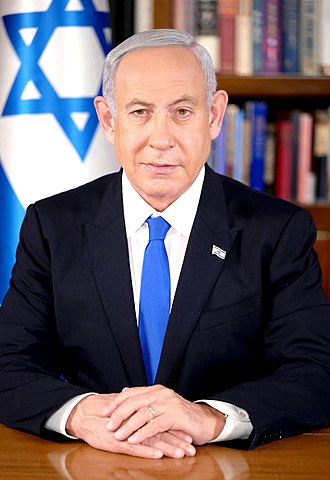 Benjamin Netanyahub. 1949Prime Minister of Israel (born 1949), (1996–1999; 2009–2021; 2022–present)Source: Wikidata (citizenship)
 Natalie Portmanb. 1981Israeli-American actress (born 1981)Source: Wikidata (citizenship)
 Golda Meir1898 – 1978Prime Minister of Israel from 1969 to 1974Source: Wikidata (citizenship)
 David Ben-Gurion1886 – 1973Israeli politician, Zionist leader, prime minister of Israel (1948–1953, 1955–1963) - (born1886–1973)Source: Wikidata (citizenship)
 Shimon Peres1923 – 2016Israeli politician (1923–2016) –Former President of Israel (2007–2014) and Prime Minister of Israel (1977, 1984–1986, 1995–1996)Source: Wikidata (citizenship)
 Ariel Sharon1928 – 2014Prime Minister of Israel from 2001 to 2006 (1928-2014)Source: Wikidata (citizenship)
 Yitzhak Rabin1922 – 1995Israeli politician, statesman and general (1922–1995)Source: Wikidata (citizenship)
 Elie Wiesel1928 – 2016Romanian-born American writer, professor, political activist, Nobel laureate, and Holocaust survivor (1928-2016)Source: Wikidata (citizenship)
 Mahmoud Abbasb. 1935President of the Palestinian Authority since 2005Source: Wikidata (country of birthplace)
 Menachem Begin1913 – 1992Israeli politician and former Prime Minister (1913–1992)Source: Wikidata (citizenship)
 Shmuel Yosef Agnon1887 – 1970Ukrainian-born Israeli Hebrew writer, Nobel laureate in Literature (1888–1970)Source: Wikidata (citizenship)
 Josephus37 CE – 100 CERoman–Jewish historian and military leader (c. 37–c. 100)Source: Wikidata (country of birthplace)
 Gal Gadotb. 1985Israeli actress, and model; Miss Israel 2004 (born 1985)Source: Wikidata (citizenship)
 Edward Said1935 – 2003Palestinian-American professor (1935–2003)Source: Wikidata (country of birthplace)
 Ada Yonath1939 – 2026Israeli structural biologist and Nobel laureate (1939–2026)Source: Wikidata (citizenship)
 Yuval Noah Hararib. 1976Israeli historian and author of popular science bestsellersSource: Wikidata (citizenship)
 Ghil'ad Zuckermannb. 1971Linguist, language revivalist, professor, author, hyperpolyglotSource: Wikidata (citizenship)
 Naftali Bennettb. 1972Prime Minister of Israel from 2021 to 2022Source: Wikidata (citizenship)
 Ehud Olmertb. 1945Prime Minister of Israel from 2006 to 2009Source: Wikidata (citizenship)
 Eusebius of Caesarea265 CE – 340 CEGreek Christian scholar, c. 260–c. 339Source: Wikidata (country of birthplace)
 Moshe Dayan1915 – 1981Israeli military leader and politician (1915–1981)Source: Wikidata (citizenship)
 Martin Buber1878 – 1965German Jewish Existentialist philosopher and theologian (1878–1965)Source: Wikidata (citizenship)
 Daniel Kahneman1934 – 2024Israeli-American psychologist and economist (1934–2024)Source: Wikidata (citizenship)
 Isaac Herzogb. 1960President of Israel since 2021Source: Wikidata (citizenship)
 Reuven Rivlinb. 193910th President of Israel (2014–2021)Source: Wikidata (citizenship)
 Yair Lapidb. 1963Leader of the Opposition in the Knesset (Israeli Parliament), Former Prime Minister of Israel in 2022 and Chairman of the Yesh Atid PartySource: Wikidata (citizenship)
 Isaac Shamir1915 – 20127th Prime Minister of Israel (1915-2012)Source: Wikidata (citizenship)
 Dan Shechtmanb. 1941Israeli scientistSource: Wikidata (citizenship)
 Chaim Weizmann1874 – 1952Israeli statesman and British chemist (1874–1952)Source: Wikidata (citizenship)
- Procopiusc. 500 CE – 565 CE6th-century historianSource: Wikidata (country of birthplace)
 Ehud Barakb. 194210th Prime Minister of IsraelSource: Wikidata (citizenship)
 Tzipi Livnib. 1958Israeli politician, former Israeli Foreign Minister and former leader of the Coalition: Zionist Union together with Isaac Herzog from 2015 to 2019Source: Wikidata (citizenship)
 Amos Oz1939 – 2018Israeli writer, novelist, journalist and intellectual (1939–2018)Source: Wikidata (citizenship)
 Roman Abramovichb. 1966Russian-Israeli-Portuguese oligarch and former politician (born 1966)Source: Wikidata (citizenship)
 Aaron Ciechanoverb. 1947Israeli physician and biochemist, Nobel LaureateSource: Wikidata (citizenship)
 Robert Aumannb. 1930Israeli-American mathematicianSource: Wikidata (citizenship)
 Levi Eshkol1895 – 1969Israeli politician, a founder of the Israeli Labor Party and Prime Minister (1895-1969)Source: Wikidata (citizenship)
 Herod Antipas20 BCE – 39 CE1st century AD tetrarch of Galilee and PereaSource: Wikidata (country of birthplace)
 Netta Barzilaib. 1993Israeli singerSource: Wikidata (citizenship)
 Moshe Katsavb. 19458th President of Israel (2000–2007)Source: Wikidata (citizenship)
 Michael Levittb. 1947Biophysicist and Professor of Structural biologySource: Wikidata (citizenship)
 Maximus the Confessor579 CE – 662 CEChristian monk, theologian, scholar and saint (c. 580 - 662)Source: Wikidata (country of birthplace)
 Moshe Sharett1894 – 19652nd Prime Minister of Israel from 1954 to 1955Source: Wikidata (citizenship)
 Avram Hershkob. 1937Israeli biochemistSource: Wikidata (citizenship)
 Max Brod1884 – 1968Bohemian-Israeli author, composer, and journalist (1884–1968)Source: Wikidata (citizenship)
 Yochanan Vollachb. 1945Israeli footballerSource: Wikidata (citizenship)
 Dana Internationalb. 1969Israeli singerSource: Wikidata (citizenship)
 Chaim Herzog1918 – 19976th President of Israel (1983–1993) – (born1918–1997)Source: Wikidata (citizenship)
Showing the 48 best-known of 63 people.
Everything that happened
- 1,457 BCEBattle of MegiddoTel MegiddoThe Battle of Megiddo (fought 15th century BC) was fought between Egyptian forces under the command of Pharaoh Thutmose III and a large rebellious coalition of Canaanite vassal states led by the king of Kadesh. It is the first battle to have been recorded in what is accepted as relatively reliable detail. Megiddo is also the first recorded use of the composite bow and the first body count.Source: Wikidata (country of the location)
- 736 BCE – 732 BCESyro-Ephraimite WarPalestineThe Syro-Ephraimite War was a conflict which took place in the 8th century BCE between the Kingdom of Judah and an alliance of Aram-Damascus and the Kingdom of Israel based in Samaria. One theory states that the war's sole goal was to force Judah to join the anti-Assyrian coalition. In 735 BCE, kings Rezin of Aram-Damascus and Pekah of Israel, attempted to depose king Ahaz of Judah through an invasion.Source: Wikidata (country of the location)
- 701 BCEAssyrian siege of JerusalemJerusalemThe Assyrian siege of Jerusalem (c. 701 BC) was an aborted siege of Jerusalem, then capital of the Kingdom of Judah, carried out by Sennacherib, king of the Neo-Assyrian Empire. The siege concluded Sennacharib's campaign in the Levant, in which he attacked the fortified cities and devastated the countryside of Judah in a campaign of subjugation. Sennacherib besieged Jerusalem, but did not capture it.Source: Wikidata (country of the location)
- 701 BCESiege of LachishLachishThe siege of Lachish was the Neo-Assyrian Empire's siege and conquest of the town of Lachish in 701 BC. The siege is documented in several sources including the Hebrew Bible, Assyrian documents and in the Lachish relief, a well-preserved series of reliefs which once decorated the Assyrian king Sennacherib's palace at Nineveh.Source: Wikidata (country of the location)
- 609 BCEBattle of MegiddoTel MegiddoThis Battle of Megiddo is recorded as having taken place in 609 BC, when Pharaoh Necho II of Egypt led his army to Carchemish (northern Syria) to join with his allies, the fading Neo-Assyrian Empire, against the surging Neo-Babylonian Empire. This required passing through territory controlled by the Kingdom of Judah. The Judaean king Josiah refused to let the Egyptians pass.Source: Wikidata (country of the location)
- 597 BCESiege of JerusalemJerusalemThe siege of Jerusalem (597 BC) was a military campaign carried out by Nebuchadnezzar II, king of the Neo-Babylonian Empire, in which he besieged Jerusalem, then capital of the Kingdom of Judah. The city surrendered, and its king Jeconiah was deported to Babylon and replaced by his Babylonian-appointed uncle, Zedekiah.Source: Wikidata (country of the location)
- 589 BCE – 587 BCESiege of JerusalemJerusalemJerusalem was besieged from 589–587 BC, marking the final phase of Judah's revolts against Babylon. Nebuchadnezzar II, king of the Neo-Babylonian Empire, besieged Judah's capital city for approximately 30 months. The city ultimately fell in the summer of 587 BC, after which the Babylonians systematically destroyed Jerusalem and razed Solomon's Temple.Source: Wikidata (country of the location)
- 167 BCE – 160 BCEMaccabean RevoltLand of IsraelThe Maccabean Revolt (Hebrew: מֶרֶד הַמַּכַּבִּים) or the Hasmonean revolt (מֶרֶד הַחַשְׁמוֹנָאִים) was a Jewish rebellion led by the Maccabees against the Seleucid Empire and against Hellenistic influence on Jewish life.Source: Wikidata (country of the location)
- 63 BCESiege of JerusalemJerusalemThe siege of Jerusalem in 63 BC occurred during the campaigns of Roman general Pompey the Great in the East, shortly after his successful conclusion of the Third Mithridatic War. Pompey had been asked to intervene in a dispute over succession to the Hasmonean throne, which turned into a war between Hyrcanus II and Aristobulus II.Source: Wikidata (country of the location)
- 66 CE – 74 CEFirst Jewish–Roman WarJudaeaThe First Jewish–Roman War (66–73/74 CE), also known as the War of Destruction, the Great Jewish Revolt, the First Jewish Revolt, or the Jewish War, was the first of three major Jewish rebellions against the Roman Empire. Fought in the province of Judaea, it resulted in the destruction of Jerusalem and the Jewish Temple, mass displacement, land appropriation, and the dissolution of the Jewish polity.Source: Wikidata (country of the location)
- 67 CESiege of YodfatJotapataThe siege of Yodfat (Hebrew: יוֹדְפַת, also Jotapata, Iotapata, Yodefat) was a 47-day siege by Roman forces of the Jewish town of Yodfat which took place in 67 CE, during the Great Revolt. Led by Roman General Vespasian and his son Titus, both future emperors, the siege ended with the sacking of the town, the deaths of most of its inhabitants and the enslavement of the rest.Source: Wikidata (country of the location)
- 70 CESiege of JerusalemJerusalemThe siege of Jerusalem in 70 CE was the decisive event of the First Jewish Revolt against the Roman Empire (66–73 CE). Roman forces led by Titus, son of the emperor Vespasian, besieged Jerusalem, the Jewish capital and the revolt's main stronghold. After months of fighting, they breached the defenses, destroyed the Second Temple, and razed the city.Source: Wikidata (country of the location)
- 72 CE – 73 CESiege of MasadaMasadaThe hilltop fortress of Masada, in present-day Israel, was successfully besieged and taken by Roman imperial forces between 72 and 73 AD, during the final period of the First Jewish–Roman War. At the time, the fortress was held by members of the Sicarii rebel group. The siege is recorded by a single contemporary written source, The Jewish War by Josephus.Source: Wikidata (country of the location)
- c. 190 CELimes ArabicusSyriaThe Limes Arabicus was a desert frontier of the Roman Empire, running north from its start in the province of Arabia Petraea. It ran northeast from the Gulf of Aqaba for about 1,500 kilometers (930 mi) at its greatest extent, reaching northern Syria and forming part of the wider Roman limes system. It had several forts and watchtowers.Source: Wikidata (country)
- 614 CESasanian conquest of JerusalemJerusalemThe Sasanian conquest of Jerusalem in early 614 was a significant development in the Byzantine–Sasanian War of 602–628. It was the result of a major offensive by the Sasanian Empire across the Fertile Crescent, culminating in the annexation of Jerusalem and Palaestina Prima as a whole.Source: Wikidata (country of the location)
- 634 CEBattle of AjnadaynAjnadaynThe Battle of Ajnadayn (Arabic: معركة أجنادين) was fought in July or August 634 (Jumada I or II, 13 AH), in a location close to Bayt Jibrin; it was the first major pitched battle between the Byzantine (Roman) Empire and the army of the Arab Rashidun Caliphate. The result of the battle was a decisive Muslim victory.Source: Wikidata (country of the location)
- 636 CE – 637 CEFirst Muslim conquest of JerusalemJerusalemBetween 636 and 637/38, during the Muslim conquest of the Levant, the Rashidun Caliphate took Jerusalem from the Byzantine Empire. It began when the Rashidun army, under the command of Abu Ubayda, besieged Jerusalem in November 636. After six months, Patriarch Sophronius agreed to surrender, on condition that he submit only to the caliph.Source: Wikidata (country of the location)
- 1099Siege of JerusalemJerusalemThe siege of Jerusalem from 7 June 1099 to 15 July 1099 marked the successful end of the First Crusade, and the founding of the Kingdom of Jerusalem soon afterwards. The siege was carried out by the Christian forces of Western Europe mobilized by Pope Urban II after the Council of Clermont in 1095.Source: Wikidata (country of the location)
- 1099Battle of AscalonAshkelonThe Battle of Ascalon took place on 12 August 1099 shortly after the capture of Jerusalem. Often considered the last action of the First Crusade, the Crusader army led by Godfrey of Bouillon defeated and drove off a Fatimid army of Egypt.Source: Wikidata (country of the location)
- 1101Battle of RamlaRamlaThe First Battle of Ramla (or Ramleh) took place on 7 September 1101 between the Kingdom of Jerusalem and the Fatimids of Egypt. The town of Ramla lay on the road from Jerusalem to Ascalon, the latter of which was the largest Fatimid fortress in Palestine. From Ascalon the Fatimid vizier, Al-Afdal Shahanshah, launched almost annual attacks into the newly founded Crusader kingdom from 1099 to 1107.Source: Wikidata (country of the location)
- 1102Battle of RamlaRamlaThe Second Battle of Ramla (or Ramleh) took place in the Levant on 17 May 1102 between the Kingdom of Jerusalem and the Fatimid Caliphate of Egypt.Source: Wikidata (country of the location)
- 1105Battle of RamlaRamlaThe Third Battle of Ramla (or Ramleh) took place on 27 August 1105 between the Kingdom of Jerusalem and the Fatimids of Egypt.Source: Wikidata (country of the location)
- 1123Battle of YibnehYavneIn the Battle of Yibneh (Yibna) in 1123, a Crusader force led by Eustace Grenier crushed a Fatimid army from Egypt sent by vizier Al-Ma'mun between Ascalon and Jaffa.Source: Wikidata (country of the location)
- 1147 – 1149Second CrusadeIberian PeninsulaThe Second Crusade (1147–1149) was the second major crusade launched from Europe. The Second Crusade was started in response to the fall of the County of Edessa in 1144 to the Seljuk forces of Zengi. The county had been founded during the First Crusade (1096–1099) by Baldwin in 1098. While it was the first Crusader state to be founded, it was also the first to fall.Source: Wikidata (country of the location)
- 1153Siege of AscalonAshkelonThe siege of Ascalon took place from 25 January to 22 August 1153, in the time period between the Second and Third Crusades, and resulted in the capture of the Fatimid Egyptian fortress by the Kingdom of Jerusalem.Source: Wikidata (country)
- 1157Battle of Lake HulehHula ValleyIn the Battle of Lake Huleh in June 1157, a Crusader army led by King Baldwin III of Jerusalem was ambushed and badly defeated by Nur ad-Din Zangi, the emir of Aleppo and Damascus. While the king and some fighting men escaped to a nearby castle, a large number were killed or made prisoner. The Latin Kingdom of Jerusalem escaped worse damage when their adversary became ill and was unable to follow up his victory.Source: Wikidata (country of the location)
- 1177Battle of MontgisardRamlaThe Battle of Montgisard was fought between the Kingdom of Jerusalem and the Ayyubid Sultanate of Egypt on 25 November 1177 at Montgisard, in the Levant between Ramla and Yibna.Source: Wikidata (country of the location)
- 1179Siege of Jacob's FordDaughters of Jacob BridgeThe siege of Jacob's Ford was a victory of the Muslim Sultan Saladin over an unnamed Templar Castellan of Jacob's Ford. It occurred in August 1179, when Saladin conquered and destroyed Chastelet, a new border castle built by the Knights Templar at Jacob's Ford on the upper Jordan River, a historic passage point between the Golan Heights and north Galilee.Source: Wikidata (country of the location)
- 1182Battle of Belvoir CastleBelvoir FortressThe Battle of Belvoir Castle, also called the Battle of Le Forbelet, was a part of Saladin's campaign in May — August 1182 against the Crusaders. Crusader forces led by King Baldwin IV of Jerusalem battled with Ayyubid forces from Egypt commanded by Saladin. Saladin took action in Damascus on June 11, 1182, together with his regent Farrukh Shah.Source: Wikidata (country of the location)
- 1183Battle of al-FuleAfulaIn the campaign and Battle of al-Fule (in Crusader terms La Fève, Latin Castrum Fabe), a Crusader force led by Guy of Lusignan skirmished with Saladin's Ayyubid army for more than a week in September and October 1183. The fighting ended on 6 October with Saladin being forced to withdraw.Source: Wikidata (country of the location)
- 1187Battle of HattinHorns of HattinThe Battle of Hattin took place on 4 July 1187, between the Crusader states of the Levant and the forces of the Ayyubid Sultanate of Egypt, led by Sultan Saladin. It is also known as the Battle of the Horns of Hattin, due to the shape of the nearby extinct volcano of that name.Source: Wikidata (country of the location)
- 1187Battle of CressonNazarethThe Battle of Cresson was a small battle between Frankish and Egyptian Ayyubid forces on 1 May 1187 at the "Spring of the Cresson." While the exact location of the spring is unknown, it is located in the environs of Nazareth. The conflict was a prelude to the decisive defeat of the Kingdom of Jerusalem at the Battle of Hattin two months later.Source: Wikidata (country of the location)
- 1187Siege of JerusalemJerusalemThe siege of Jerusalem lasted from 20 September to 2 October 1187, when Balian of Ibelin surrendered the city to the forces of the Ayyubid Sultanate under sultan Saladin. Earlier that summer, Egyptian forces under Saladin had defeated the kingdom's army and conquered several cities. Balian was charged with organizing a defense. The city was full of refugees but had few soldiers.Source: Wikidata (country of the location)
- 1189 – 1191Siege of AcreAcreThe siege of Acre was the first significant counterattack by Guy of Jerusalem against Saladin, Sultan of Egypt and Syria. This pivotal siege formed part of what later became known as the Third Crusade.Source: Wikidata (country of the location)
- 1191Battle of ArsufArsufThe Battle of Arsuf took place on 7 September 1191, as part of the Third Crusade. It saw a multi-national force of Crusaders, led by Richard I of England, defeat a significantly larger army of the Ayyubid Sultanate, led by Saladin.Source: Wikidata (country of the location)
- 1192Battle of JaffaJaffaThe Battle of Jaffa took place during the Crusades, as one of a series of campaigns between the army of Sultan Saladin (Ṣalāḥ al-Dīn Yūsuf ibn Ayyūb) and the Crusader forces led by King Richard I of England (known as Richard the Lionheart). It was the final battle of the Third Crusade, after which Saladin and King Richard were able to negotiate a truce.Source: Wikidata (country of the location)
- 1244Siege of JerusalemJerusalemThe siege of Jerusalem of 1244 took place after the Sixth Crusade, when a Khwarazmian army conquered the city on July 15, 1244.Source: Wikidata (country of the location)
- 1260Battle of Ain JalutWell of HarodThe Battle of Ain Jalut (Arabic: معركة عين جالوت, romanized: Ma'rakat 'Ayn Jālūt), also spelled Ayn Jalut, was fought between the Bahri Mamluks of Egypt and the Ilkhanate on 3 September 1260 near the spring of Ain Jalut in southeastern Galilee in the Jezreel Valley. It marks the first major halt to Mongolian advances and paused their expansion into Arabia and Europe.Source: Wikidata (country of the location)
- 1291Siege of AcreAcreThe siege of Acre (also called the fall of Acre) took place in 1291 and resulted in the Crusaders' losing control of Acre to the Mamluk Sultanate of Egypt. It is considered one of the most important battles of the period. Although the crusading movement continued for several more centuries, the capture of the city marked the end of further crusades to the Levant.Source: Wikidata (country of the location)
- 1799Battle of Mount TaborMount TaborThe Battle of Mount Tabor was fought on 16 April 1799 between French forces commanded by Napoleon Bonaparte and Jean-Baptiste Kléber against an Ottoman army under Abdullah Pasha al-Azm, the pasha of Damascus. The battle took place during the siege of Acre of French invasion of Egypt and Syria.Source: Wikidata (country)
- 1799Siege of AcreAcreThe siege of Acre of 1799 was an unsuccessful French siege of the Ottoman city of Acre and was the turning point of Napoleon's invasion of Egypt and Syria, along with the Battle of the Nile.Source: Wikidata (country of the location)
- 1799Siege of JaffaJaffaThe siege of Jaffa was a military engagement between the French Army under Napoleon Bonaparte and Ottoman forces under Ahmed al-Jazzar. On March 3, 1799, the French laid siege to the city of Jaffa, which was under Ottoman control. It was fought from March 3 to 7, when French forces managed to capture the city.Source: Wikidata (country of the location)
- 1917Battle of BeershebaBeershebaThe Battle of Beersheba (Turkish: Birüssebi Muharebesi, German: Schlacht von Beerscheba) was fought on 31 October 1917, when the British Empire's Egyptian Expeditionary Force (EEF) attacked and captured the Ottoman Empire's Yildirim Army Group garrison at Beersheba, beginning the Southern Palestine Offensive of the Sinai and Palestine campaign of World War I.Source: Wikidata (country of the location)
- 1917Battle of JerusalemJerusalemThe Battle of Jerusalem also known as the Fall of Jerusalem occurred during the British Empire's "Jerusalem Operations" against the Ottoman Empire, in World War I, when fighting for the city developed from 17 November, continuing after the surrender until 30 December 1917, to secure the final objective of the Southern Palestine Offensive during the Sinai and Palestine Campaign of World War I.Source: Wikidata (country of the location)
- 1918Battle of MegiddoSharon PlainThe Battle of Megiddo was fought between 19 and 25 September 1918, on the Plain of Sharon, in front of Tulkarm, Tabsor and Arara in the Judean Hills as well as on the Esdralon Plain at Nazareth, Afulah, Beisan, Jenin and Samakh.Source: Wikidata (country)
- 1946King David Hotel bombingKing David HotelThe British administrative headquarters for Mandatory Palestine, housed in the southern wing of the King David Hotel in Jerusalem, were bombed in a terrorist attack on 22 July 1946, by the militant right-wing Zionist underground organization Irgun during the Jewish insurgency. 91 people of various nationalities were killed, including Arabs, Britons and Jews, and 46 were injured.Source: Wikidata (country of the location)
- 1947 – 19491948 Palestine warLevantThe 1948 Palestine war (30 November 1947 – 10 March 1949), known in Palestine as the Nakba and in Israel as the War of Independence, was fought in the territory of what had been, at the start of the war, British-ruled Mandatory Palestine.Source: Wikidata (country)
- 1947 – 1948Battle for JerusalemJerusalemThe Battle for Jerusalem took place during the 1947–1948 civil war phase of the 1947–1949 Palestine war. It saw Jewish and Arab militias in Mandatory Palestine, and later the militaries of Israel and Transjordan, fight for control over the city of Jerusalem.Source: Wikidata (country of the location)
- 1948 – 19491948 Arab–Israeli WarIsrael and PalestineIsrael declares independence on 14 May 1948 as the British Mandate ends, and neighboring Arab states go to war. About 700,000 Palestinians flee or are expelled from their homes, an event Palestinians call the Nakba (“catastrophe”).Source: Wikidata (country of the location)
- 1948Israeli Declaration of IndependencePalestineThe Israeli Declaration of Independence, formally the Declaration of the Establishment of the State of Israel (Hebrew: הכרזה על הקמת מדינת ישראל), was proclaimed at the Tel Aviv Museum on 14 May 1948 (5 Iyar 5708), at the end of the civil war phase and beginning of the Arab–Israeli War of the 1948 Palestine war, by the Va'ad Leumi led by David Ben-Gurion, the executive head of the World Zionist Organization and…Source: Wikidata (country of the location)
- 1948Deir Yassin massacreDeir YassinThe Deir Yassin massacre took place on 9 April 1948, when Zionist paramilitaries attacked the village of Deir Yassin near Jerusalem, then part of Mandatory Palestine, killing at least 107 Palestinian Arab villagers, including women and children. The attack was conducted primarily by the Irgun and Lehi, who were supported by the Haganah and Palmach.Source: Wikidata (country of the location)
- 1948Eilabun massacreEilabunThe Eilabun massacre was committed on 30 October 1948 by the Israel Defense Forces as part of the 1948 Palestine war. A total of 14 men from the Arab Christian village of Eilabun were killed, 12 of them executed by the Israeli forces after the village had surrendered.Source: Wikidata (country)
- 1948Gaza–Israel conflictSouthern LevantThe Gaza–Israel conflict is a localized part of the Israeli–Palestinian conflict beginning in 1948, when about 200,000 of the more than 700,000 Palestinians who fled or were expelled from their homes settled in the Gaza Strip as refugees. Since then, Israel and Palestinian militant groups have fought 15 wars in the Gaza Strip.Source: Wikidata (country)
- 1948Hadassah medical convoy massacreJerusalemThe Hadassah convoy massacre took place on April 13, 1948, when a convoy, escorted by Haganah militia, bringing medical and military supplies and personnel to Hadassah Hospital on Mount Scopus, Jerusalem, was ambushed by Arab forces. Seventy-eight Jewish doctors, nurses, students, patients, faculty members and Haganah fighters, and one British soldier were killed in the attack, including twenty three women.Source: Wikidata (country of the location)
- 1948Operation DaniJaffaOperation Dani, also spelled Danny, was an Israeli military offensive launched on July 9–19, 1948 at the end of the first truce of the 1948 Arab–Israeli War. The objectives were to capture territory east of Tel Aviv and then to push inland and relieve the Jewish population and forces in Jerusalem. The main forces fighting against the IDF were the Arab Legion and Palestinian irregularsSource: Wikidata (country of the location)
- 1948Operation HiramUpper GalileeOperation Hiram was a military operation conducted by the Israel Defense Forces (IDF) during the 1948 Arab–Israeli War. It was led by General Moshe Carmel, and aimed at capturing the Upper Galilee region from the Arab Liberation Army (ALA) forces led by Fawzi al-Qawuqji and a Syrian battalion.Source: Wikidata (country of the location)
- 1948Operation YoavNegevOperation Yoav (also called Operation Ten Plagues or Operation Yo'av) was an Israeli military operation carried out from 15–22 October 1948 in the Negev Desert, during the 1948 Arab–Israeli War. Its goal was to drive a wedge between the Egyptian forces along the coast and the Beersheba–Hebron–Jerusalem road, and ultimately to conquer the whole Negev.Source: Wikidata (country of the location)
- 1949Ink FlagIsraelThe Ink Flag (Hebrew: דֶּגֶל הַדְּיוֹ, Degel HaDyo) was a handmade Israeli flag raised in March 1949 during the 1948 Arab–Israeli War to mark the capture of Umm Rashrash. The flag’s display in what later became the city of Eilat was replaced two hours later by an official flag when the Golani Brigade arrived. The raising of the Ink Flag is considered to be the end of the war and the birth of Israel.Source: Wikidata (country)
- 1949 – 1950Operation Magic CarpetIsraelOperation Magic Carpet is the widely known nickname for Operation On Wings of Eagles (Hebrew: כנפי נשרים Kanfe Nesharim), which was conducted by Israel between 16 December 1948 and 24 September 1950 to take in approximately 49,000 Yemenite Jews as part of the Jewish exodus from the Muslim world. The name derives from the biblical image of Israel being carried "on eagles' wings" (Exodus 19:4 and Isaiah 40:31).Source: Wikidata (country)
- 1956Kafr Qasim massacreKafr QasimThe Kafr Qasim massacre (Arabic: مذبحة كفر قاسم, Hebrew: טבח כפר קאסם) was the killing by the Israel Border Police of 49 Palestinian civilians, including 19 men, 6 women and 23 children, in the Israeli Arab village of Kafr Qasim on 29 October 1956, the eve of the Sinai War.Source: Wikidata (country)
- 1970Avivim school bus bombingRoute 899The Avivim school bus bombing was a terrorist attack on an Israeli school bus on 22 May 1970, in which 12 civilians were killed, nine of them children, and 25 were wounded, one of whom died of a wound sustained in the attack 44 years later. The attack took place on the road to Moshav Avivim, near Israel's border with Lebanon. Two rocket-propelled grenades were fired at the bus.Source: Wikidata (country)
- 1972Lod Airport massacreBen Gurion AirportThe Lod Airport massacre was an attack that was carried out by the Japanese Red Army on the Lod Airport (now Ben Gurion International Airport) near Tel Aviv on 30 May 1972. It resulted in the killing of 26 people and the wounding of 80 others. Two of the attackers (Tsuyoshi Okudaira and Yasuyuki Yasuda) were killed, while a third (Kōzō Okamoto) was captured after being wounded.Source: Wikidata (country)
- 1973October (Yom Kippur) WarSinai and Golan HeightsEgypt and Syria launch a surprise attack in October 1973 to win back land lost in 1967. The war also triggers an Arab oil embargo against Western supporters of Israel.Source: Wikidata (country of the location)
- 1974Kiryat Shmona massacreKiryat ShmonaThe Kiryat Shmona massacre was an attack by three members of the Popular Front for the Liberation of Palestine - General Command on civilians in Kiryat Shmona, Israel during the Jewish holiday of Passover on 11 April 1974. Eighteen people were killed, 8 of them children, and 16 people were wounded.Source: Wikidata (country of the location)
- 1974Ma'alot massacreMa'alot-TarshihaThe Ma'alot massacre was a Palestinian terrorist attack that occurred on 14–15 May 1974 and involved the hostage-taking of 115 Israelis, chiefly school children, which ended in the murder of 25 hostages and six other civilians. It began when three armed members of the Democratic Front for the Liberation of Palestine (DFLP) infiltrated Israel from Lebanon.Source: Wikidata (country of the location)
- 1978Coastal road massacreHighway 2The coastal road massacre occurred on 11 March 1978, when Palestinian militants hijacked a bus on the Coastal Highway of Israel and murdered its occupants; 38 Israeli civilians, including 13 children, were killed as a result of the attack while 76 more were wounded.Source: Wikidata (country)
- 1979Egypt–Israel peace treatyWashington, D.C.Egypt becomes the first Arab state to sign a peace treaty with Israel, following the 1978 Camp David Accords. Israel returns the Sinai by 1982.Source: Wikidata (country)
- 1984 – 1985Operation MosesSudanOperation Moses (Hebrew: מִבְצָע מֹשֶׁה, Mivtza Moshe) was the covert evacuation of Ethiopian Jews (known as the "Beta Israel" community from Sudan during a civil war that caused a famine in 1984. Originally called Gur Aryeh Yehuda ("Cub of the Lion of Judah") by Israelis, the United Jewish Appeal changed the name to "Operation Moses".Source: Wikidata (country of the location)
- 1987 – 1993First IntifadaGaza and West BankA Palestinian uprising against Israeli occupation begins in Gaza in December 1987 and spreads to the West Bank.Source: Wikidata (country)
- 1990 – 1991Invasion and liberation of KuwaitKuwaitIraq invades Kuwait on 2 August 1990. A US-led coalition liberates the country on 26 February 1991.Source: Wikidata (country of the location)
- 1993Oslo I AccordIsraelThe Oslo I Accord or Oslo I, officially called the Declaration of Principles on Interim Self-Government Arrangements or short Declaration of Principles (DOP), was an attempt in 1993 to set up a framework that would lead to the resolution of the ongoing Israeli–Palestinian conflict. It was the first face-to-face agreement between the government of Israel and the Palestine Liberation Organization (PLO).Source: Wikidata (country)
- 1995Assassination of Yitzhak RabinTel AvivYitzhak Rabin, the prime minister of Israel, was assassinated on 4 November 1995 at 21:30, at the end of a rally in support of the Oslo Accords at Kings of Israel Square in Tel Aviv. The assailant was Yigal Amir, an Israeli law student and far-right ultranationalist who radically opposed the Oslo Accords and Rabin's peace initiative more broadly.Source: Wikidata (country)
- c. 2000Israeli–Lebanese conflictLevantThe Israeli–Lebanese conflict, or the South Lebanon conflict, is a long-running conflict involving Israel, Lebanon-based paramilitary groups, and sometimes Syria. The conflict peaked during the Lebanese Civil War. In response to Palestinian attacks from Lebanon, Israel invaded the country in 1978 and again in 1982.Source: Wikidata (country)
- 20062006 Lebanon WarSouthern LebanonThe 2006 Lebanon War was a 34-day armed conflict in Lebanon, fought between Hezbollah and Israel. The war started on 12 July 2006 and continued until a United Nations-brokered ceasefire went into effect in the morning on 14 August 2006, though it formally ended on 8 September 2006 when Israel lifted its naval blockade of Lebanon. It marked the third Israeli invasion into Lebanon since 1978.Source: Wikidata (country)
- 2008 – 2009Gaza WarGaza StripThe Gaza War, also known as the First Gaza War, Operation Cast Lead, or the Gaza Massacre, and referred to as the Battle of al-Furqan by Hamas, was a three-week armed conflict between Gaza Strip Palestinian paramilitary groups and the Israel Defense Forces (IDF) that began on 27 December 2008 and ended on 18 January 2009 with a unilateral ceasefire.Source: Wikidata (country of the location)
- 20112011 southern Israel cross-border attacksSouthern DistrictOn August 18, 2011, a series of cross-border attacks with parallel attacks and mutual cover was carried out in southern Israel on Highway 12 near the Egyptian border by a squad of presumably twelve militants in four groups. The attacks occurred after Israel's interior security service Shin Bet had warned of an attack by militants in the region and Israeli troops had been stationed in the area.Source: Wikidata (country)
- 20122012 Gaza WarGaza StripIn November 2012, the Israel Defense Forces (IDF) launched Operation Pillar of Defense (Hebrew: עַמּוּד עָנָן, ʿAmúd ʿAnán, literally: "Pillar of Cloud"), which was an eight-day campaign in the Hamas-governed Gaza Strip, beginning on 14 November 2012 with the killing of Ahmed Jabari, chief of the Gaza military wing of Hamas, by an Israeli airstrike.Source: Wikidata (country of the location)
- 20142014 Gaza WarGaza StripThe 2014 Gaza War, also known as Operation Protective Edge (Hebrew: מִבְצָע צוּק אֵיתָן, romanized: Miv'tza Tzuk Eitan, lit. 'Operation Strong Cliff'), and Battle of the Withered Grain (Arabic: معركة العصف المأكول, romanized: Maʿrakat al-ʿAṣf al-Maʾkūl), was a military operation launched by Israel on 8 July 2014 in the Gaza Strip, a Palestinian territory governed by Hamas since 2007 and which was occupied by Israel…Source: Wikidata (country)
- 20142014 kidnapping and murders of Israeli teenagersGush EtzionThe 2014 Gush Etzion kidnapping and murder refers to the abduction and killing of three Israeli teenagers in the West Bank during June 2014. The victims, Eyal Yifrach, Gilad Shaer, and Naftali Fraenkel, were Israeli students aged 16 and 19. On the evening of 12 June 2014, the three teenagers were hitchhiking in the Alon Shvut settlement in Gush Etzion, in the West Bank when they were abducted.Source: Wikidata (country of the location)
- 20182018–2019 Gaza border protestsIsrael–Gaza Strip borderThe 2018–2019 Gaza border protests, also known as the Great March of Return (Arabic: مسیرة العودة الكبرى, romanized: Masīra al-ʿawda al-kubrā), were a series of demonstrations held each Friday in the Gaza Strip near the Gaza–Israel barrier from 30 March 2018 until 27 December 2019, in which Israel killed a total of 223 Palestinians.Source: Wikidata (country of the location)
- 2018February 2018 Israel–Syria incidentLevantOn 10 February 2018, an Israeli F-16 was shot down by the Syrian air defenses after conducting an air raid on Iran-backed positions inside Syrian territory. The aircraft was part of a larger Israeli aerial dispatch which Israel said was sent in response to detection of an Iranian drone spying on Israel.Source: Wikidata (country)
- 2020COVID-19 pandemicWorldwideA new coronavirus spreads worldwide. Lockdowns, remote work and fast-developed vaccines reshape daily life.Source: Wikidata (country)
- 2020COVID-19 pandemic in IsraelIsraelThe COVID-19 pandemic in Israel was part of the worldwide pandemic of coronavirus disease 2019 (COVID-19) caused by severe acute respiratory syndrome coronavirus 2 (SARS-CoV-2). The first case in Israel was confirmed on 21 February 2020, when a female citizen tested positive for COVID-19 at the Sheba Medical Center after return from quarantine on the Diamond Princess ship in Japan.Source: Wikidata (country)
- 20212021 Israel–Palestine crisisSouthern LevantA major outbreak of violence in the Israeli–Palestinian conflict, sometimes called the Unity Intifada, mainly commenced on 10 May 2021 and continued until a ceasefire came into effect on 21 May. It was marked by protests and police riot control, rocket attacks on Israel by Hamas and Palestinian Islamic Jihad (PIJ), and Israeli airstrikes in the Gaza Strip.Source: Wikidata (country)
- 20212021 Meron crowd crushtomb of Shimon bar YochaiOn 30 April 2021, at about 00:45 IDT (UTC+3), a deadly crowd crush occurred on Mount Meron, Israel, during the annual pilgrimage to the tomb of Rabbi Shimon bar Yochai on the Jewish holiday of Lag BaOmer, at which it was estimated that 100,000 people were in attendance.Source: Wikidata (country)
- 20222022 Al-Aqsa clashesJerusalemOn 15 April 2022, clashes erupted between Palestinians and Israeli Security Forces on the Al-Aqsa compound in the Old City of Jerusalem. According to the United Nations Special Coordinator for the Middle East Peace Process, the clashes began when Palestinians threw stones, firecrackers, and other heavy objects at Israeli police officers.Source: Wikidata (country of the location)
- 20222022 Gaza–Israel clashesGaza StripThe 2022 Gaza–Israel clashes code-named as Operation Breaking Dawn lasted from 5 to 7 August 2022. The Israel Defense Forces (IDF) conducted some 147 airstrikes in Gaza and Palestinian militants fired approximately 1,100 rockets towards Israel.Source: Wikidata (country)
- 2023Gaza warLevantThe Gaza war is an armed conflict in the Gaza Strip and Israel, fought as part of the unresolved Israeli–Palestinian and Gaza–Israel conflicts. The war began on 7 October 2023, when Palestinian militant group Hamas led an attack on Israel, in which 1,195 Israelis and foreign nationals were killed and 251 were taken hostage.Source: Wikidata (country)
- 2023October 7 attack and Gaza warIsrael and GazaHamas-led militants attack southern Israel on 7 October 2023, killing about 1,200 people and taking about 250 hostages. Israel launches a war in Gaza. Gaza’s health ministry reports tens of thousands of Palestinians killed, and most of Gaza’s population is displaced.Source: Wikidata (country)
- 20232023 Israel–Palestine tensionsJerusalemA series of violent confrontations occurred between Palestinians and Israeli police at the Al-Aqsa Mosque compound in Jerusalem in April 2023. After the evening Ramadan prayer, Palestinians barricaded themselves inside the mosque, prompted by reports that Jews planned to sacrifice a goat at the site (which is forbidden by Israeli law).Source: Wikidata (country)
- 20232023 Neve Yaakov shootingNeve YaakovOn 27 January 2023, a Palestinian gunman killed at least seven civilians in the Israeli settlement of Neve Yaakov, in East Jerusalem, the occupied West Bank. The suspect is also reported as having shot at worshippers exiting a synagogue, and, according to the police, was shot and killed after he opened fire on the attending officers.Source: Wikidata (country)
- 2023Alumim massacreAlumimOn 7 October 2023, dozens of Hamas militants attacked Alumim, a kibbutz close to the border fence with the Gaza Strip, as part of the surprise attack on Israel. There were 41 Thai and Nepalese foreigners working at the kibbutz. The militants killed between 16 and 17 of these workers and kidnapped between five and eight of them. The kibbutz's security team were too far away and unable to save the employees.Source: Wikidata (country)
- 2023Battle of Re'imRe'imThe battle of Re'im (Hebrew: קרב רעים; Arabic: معركة رعيم) took place on October 7, 2023, when Hamas attacked Israel, initiating the Gaza war. At 10:00 am, less than five hours after Hamas attacked, fighting was reported outside of the Re'im Army Base, which is headquarters for the Gaza Division.Source: Wikidata (country)
- 2023Battle of SderotSderotThe battle of Sderot (Hebrew: קרב שדרות; Arabic: معركة سديروت) began on 7 October 2023, when Hamas launched a large-scale surprise attack on southern Israel, which was widely condemned as an act of terrorism.Source: Wikidata (country)
- 2023Be'eri massacreBe'eriDuring the October 7 attacks on Israel, Hamas militants carried out a massacre at Be'eri, a kibbutz near the Gaza Strip. Hundreds of Gazan militants and civilian looters attacked the kibbutz, killing and abducting civilians while facing resistance from armed residents. Israeli security forces regained control by the evening of 8 October.Source: Wikidata (country)
- 2023Hezbollah–Israel conflictSouthern LebanonAn ongoing conflict between the Lebanese militant group Hezbollah and Israel began on 8 October 2023, when Hezbollah launched rockets and artillery at Israeli positions following Hamas's October 7 attacks on Israel. The conflict escalated into a prolonged exchange of bombardments, leading to extensive displacement in Israel and Lebanon.Source: Wikidata (country)
- 2023Israeli blockade of the Gaza StripGaza–Israel barrierOn 9 October 2023, Israel intensified its blockade of the Gaza Strip when it announced a "total blockade", blocking the entry of food, water, medicine, fuel and electricity after the October 7 attacks and the ensuing Gaza war. The blockade has been credited with contributing significantly to the Gaza genocide.Source: Wikidata (country of the location)
- 2023Kfar Aza massacreKfar AzaOn 7 October 2023, around 250 Hamas and other Palestinian militants attacked Kfar Aza, an Israeli kibbutz (cooperative community) about 3 kilometers (1.9 mi) from the border with the Gaza Strip, massacring residents and abducting hostages.Source: Wikidata (country)
- 2023May 2023 Gaza–Israel clashesGaza StripThe clashes between Israel and Palestinian Islamic Jihad in May 2023 started on 2 May 2023 when Khader Adnan, a former Palestinian Islamic Jihad (PIJ) spokesman, died in an Israeli prison following an 87-day hunger strike protesting his continual administrative detention and PIJ militants fired around 102 rockets towards southern Israel, injuring seven individuals in Sderot.Source: Wikidata (country)
- 2023Nahal Oz attackNahal OzThe kibbutz of Nahal Oz and the adjacent military base near the northern Gaza Strip were attacked in 2023 as part of the October 7 attacks. In the attack, more than 60 Israeli soldiers and 15 civilians were killed. Some soldiers and eight civilians were kidnapped and taken to the Gaza Strip. According to the IDF, several bodies were also taken to the Gaza Strip after being killed.Source: Wikidata (country)
- 2023Netiv HaAsara massacreNetiv HaAsaraThe Netiv HaAsara massacre occurred during the October 7 attacks. Three Hamas fighters on paragliders attacked Netiv HaAsara, an Israeli moshav close to the border fence. The militants killed at least 17 people. Before the massacre, the moshav was home to approximately 900 residents. The lengthy response time of the Israel Defense Forces (IDF) has been criticized by survivors.Source: Wikidata (country)
- 2023Nir Oz attackNir OzOn 7 October 2023, as part of the surprise attack on Israel, Palestinian militants from the Gaza Strip, led by Hamas, invaded the Nir Oz kibbutz in southern Israel. They killed scores of kibbutz residents, burned homes, and abducted civilians. Over 500 Palestinian militants and civilian looters participated in the massacre. A total of 47 people were killed and 76 were taken hostage in the attack.Source: Wikidata (country)
- 2023Nova music festival massacreSupernova Music Festival 2023 complexOn 7 October 2023, the al-Qassam Brigades, the military wing of the Palestinian nationalist and Islamist political organization Hamas, initiated a sudden attack on Israel from the Gaza Strip.Source: Wikidata (country)
- 2023Red Sea crisisMiddle EastThe Red Sea crisis is an ongoing armed conflict and maritime crisis instigated by the Houthis, an armed group in Yemen fighting a civil war against the country's internationally recognized government.Source: Wikidata (country of the location)
- 2023Zikim attackZikimAs part of the 7 October 2023 attack on Israel from the Gaza Strip, a military engagement took place near Zikim, Israel between Hamas militants and the Israel Defense Forces (IDF). According to Haaretz, Hamas's goal was to capture Zikim's military training base. The Israeli navy prevented most Hamas militants from landing on the beach, although an estimated 11 militants landed from a vessel that went through.Source: Wikidata (country of the location)
- 2024April 2024 Iranian strikes on IsraelIsraelOn 13 April 2024, the Islamic Revolutionary Guards Corps (IRGC), a branch of the Iranian Armed Forces, in collaboration with the Islamic Resistance in Iraq, Lebanese militant group Hezbollah, and the Ansar Allah (Houthis), launched attacks against Israel and the Israeli-occupied Golan Heights with loitering munitions, cruise missiles, and ballistic missiles.Source: Wikidata (country)
- 20242024 Lebanon warSouthern LebanonA war between Israel and Hezbollah took place in Lebanon during 2024 amid the Middle Eastern crisis. The war began in September 2024 following nearly 12 months of conflict between Israel and Hezbollah, when the former initiated major attacks in Lebanon including an attack on pagers and electronic devices, the assassination of Hezbollah leader Hassan Nasrallah, and an aerial bombing campaign throughout the country.Source: Wikidata (country)
- 2024Majdal Shams attackMajdal ShamsThe Majdal Shams attack took place on 27 July 2024, when a rocket hit a soccer field in Majdal Shams in the Israeli-occupied Golan Heights. The resulting blast killed 12 Syrian children belonging to the Druze community and injured at least 42 others, with most of the victims being between the ages of 10 and 16.Source: Wikidata (country)
- 2025Twelve-Day WarMiddle EastThe Twelve-Day War was an armed conflict between Iran and Israel which lasted from 13 to 24 June 2025. It began when Israel bombed military and nuclear facilities in Iran in a surprise attack, assassinating prominent military leaders, nuclear scientists, and politicians, killing civilians, and damaging or destroying air defenses.Source: Wikidata (country)
- 20262026 Iran warTehranSince 28 February 2026, the United States and Israel have been at war with Iran and its regional allies. The war follows the Twelve-Day War in June 2025 and sporadic fighting during the Middle Eastern crisis sparked by the Gaza war, which began in 2023.Source: Wikidata (country of the location)