Holy Roman Empire
7 events
The Holy Roman Empire, also known as the Holy Roman Empire of the German Nation after 1512, was a polity comprising and controlling much of Central Europe and Western Europe, headed by the Holy Roman Emperor and characterized by a decentralized political structure. It developed in the Early Middle Ages (beginning in either 800 or 962), and lasted for a millennium until its dissolution in 1806 during the Napoleonic Wars. Initially, it consisted of three constituent kingdoms—Germany, Italy, and (from 1032) Burgundy—held together by the emperor's overlordship.
Text from the Wikipedia article Holy Roman Empire, CC BY-SA 4.0
Built from Wikidata: an event or person is listed when Wikidata links them to this page, as shown next to each one. Many aren’t recorded there, so this list is incomplete.
Key people
 Wolfgang Amadeus Mozart1756 – 1791Austrian composer of the Classical period (1756-1791)Source: Wikidata (citizenship)
 Johann Sebastian Bach1685 – 1750German composer (1685–1750)Source: Wikidata (citizenship)
 Martin Luther1483 – 1546German priest and theologian (1483–1546)Source: Wikidata (citizenship)
 Raphael1483 – 1520Italian painter and architect (1483–1520)Source: Wikidata (citizenship)
 Johannes Kepler1571 – 1630German mathematician and astronomer (1571–1630)Source: Wikidata (citizenship)
 Johannes Gutenberg1400 – 1468German inventor and craftsman (1400-1468)Source: Wikidata (citizenship)
 George Frideric Handel1685 – 1759German-British Baroque composer (1685–1759)Source: Wikidata (citizenship)
 Joseph Haydn1732 – 1809Austrian composer (1732–1809)Source: Wikidata (citizenship)
 Charles V1500 – 1558Holy Roman Emperor from 1519 to 1556 (1500–1558)Source: Wikidata (citizenship)
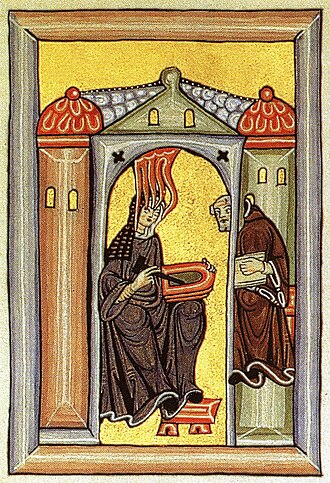 Hildegard of Bingen1098 – 1179German Benedictine abbess, polymath, mystic and Doctor of Church (1098–1179)Source: Wikidata (citizenship)
 Alessandro Manzoni1785 – 1873Italian writer and poet (1785–1873)Source: Wikidata (citizenship)
 Jan Husc. 1370 – 1415Czech theologian, philosopher and preacher (1369-1415)Source: Wikidata (citizenship)
 Frederick Barbarossa1122 – 1190Holy Roman Emperor from 1155 to 1190Source: Wikidata (citizenship)
 Klemens von Metternich1773 – 1859Austrian diplomat, foreign minister and Chancellor (1773–1859)Source: Wikidata (citizenship)
 Albertus Magnus1200 – 1280German-Dominican friar and saint (c. 1200–1280)Source: Wikidata (citizenship)
 Frederick II, Holy Roman Emperor1194 – 1250King of Sicily, Holy Roman Emperor (1194–1250, 1220–1250)Source: Wikidata (citizenship)
 Pius II1405 – 1464Pope of the Catholic Church from 1458 to 1464 (1405–1464)Source: Wikidata (citizenship)
 Adrian VI1459 – 1523Pope of the Catholic Church from 1522 to 1523 (1459–1523)Source: Wikidata (citizenship)
 Nicholas of Cusa1401 – 1464German philosopher (1401 – 1464)Source: Wikidata (citizenship)
 Joseph II, Holy Roman Emperor1741 – 1790Holy Roman Emperor from 1765 to 1790, (1741-1790).Source: Wikidata (citizenship)
 Charles IV1316 – 1378Holy Roman EmperorSource: Wikidata (citizenship)
 Georg Christoph Lichtenberg1742 – 1799German scientist and satirist (1742-1799)Source: Wikidata (citizenship)
 Willem Barents1550 – 1597Dutch navigator, cartographer, and Arctic explorer (1550–1597)Source: Wikidata (citizenship)
 Ferdinand I, Holy Roman Emperor1503 – 1564Emperador del SIR de 1556 a 1564 (1503-1564)Source: Wikidata (citizenship)
 Leo IX1002 – 1054Head of the Catholic Church from 1049 to 1054Source: Wikidata (citizenship)
 Georg Philipp Telemann1681 – 1767German composerSource: Wikidata (citizenship)
 Jean Paul1763 – 1825German Romantic writer (1763-1825)Source: Wikidata (citizenship)
 Leopold I, Holy Roman Emperor1640 – 1705Holy Roman Emperor (1658-1705), King of Hungary and Croatia and King of Bohemia (lived 1640-1705)Source: Wikidata (citizenship)
 Sigismund1368 – 1437Monarch from the House of Luxemburg (1368-1437)Source: Wikidata (citizenship)
 Hans Holbein the Younger1497 – 1543German artist and printmaker (1497–1543)Source: Wikidata (citizenship)
 Godfrey of Bouillon1060 – 1100Medieval Frankish knightSource: Wikidata (citizenship)
 Emperor Rudolf II1552 – 1612Holy Roman Emperor, King of Hungary and Croatia, King of Bohemia and Archduke of Austria (1552-1612)Source: Wikidata (citizenship)
 Leopold II, Holy Roman Emperor1747 – 1792Holy Roman Emperor from 1790 to 1792Source: Wikidata (citizenship)
 Henry IV1050 – 1106Holy Roman Emperor from 1084 to 1105Source: Wikidata (citizenship)
 Joseph von Fraunhofer1787 – 1826Bavarian physicist and optical lens manufacturerSource: Wikidata (citizenship)
 Leopold Mozart1719 – 1787German composer (1719–1787)Source: Wikidata (citizenship)
 Otto II955 CE – 983 CEHoly Roman Emperor from 973 to 983 and King of Italy from 980 to 983Source: Wikidata (citizenship)
 Ferdinand III, Holy Roman Emperor1608 – 1657Emperor of the Holy Roman Empire (1608-1657)Source: Wikidata (citizenship)
 Otto III980 CE – 1002Holy Roman Emperor from 996 to 1002Source: Wikidata (citizenship)
 Walther von der Vogelweide1170 – 1230German minstrel singer (c. 1170 – c. 1230)Source: Wikidata (citizenship)
 Christian I of Denmark1426 – 1481Scandinavian monarch under the Kalmar Union (1426-1481)Source: Wikidata (citizenship)
 Matthias, Holy Roman Emperor1557 – 1619Holy Roman Emperor (1557-1619)Source: Wikidata (citizenship)
 Wolfram von Eschenbach1170 – 1220German knight and poet (1170–1220)Source: Wikidata (citizenship)
 Lucas Cranach the Elder1472 – 1553German painter and printmaker (1472–1553)Source: Wikidata (citizenship)
 Athanasius Kircher1602 – 1680German Jesuit scholar (1601 or 1602-1680)Source: Wikidata (citizenship)
 Thomas Müntzer1489 – 1525Early Reformation-era German pastor who was a rebel leader during the German Peasants' WarSource: Wikidata (citizenship)
 Henry V1086 – 1125King of Germany and Holy Roman Emperor, the fourth and last ruler of the Salian dynastySource: Wikidata (citizenship)
 Regiomontanus1436 – 1476German mathematician and astronomer (1436–1476)Source: Wikidata (citizenship)
Showing the 48 best-known of 52 people.
Everything that happened
- 1096Rhineland massacresHoly Roman EmpireThe Rhineland massacres, also known as the German Crusade of 1096 (Hebrew: גזרות תתנ״ו, romanized: Gezērot-Tatnu, lit. 'Edicts of 4856'), were a series of mass murders of Jews in the Rhineland (part of the Holy Roman Empire) which took place in 1096, which is the year 4856 in the Hebrew calendar, which is abbreviated in Hebrew as Hebrew: גזרות תתנ״ו, romanized: taṯnu They were perpetrated by mobs of Catholic…Source: Wikidata (country)
- 1525Battle of FrankenhausenBad FrankenhausenThe Battle of Frankenhausen was fought on 14 and 15 May 1525. It was an important battle in the German Peasants' War and the final act of the war in Thuringia: joint troops of Landgrave Philip I of Hesse and Duke George of Saxony defeated the peasants under their spiritual leader Thomas Müntzer near Frankenhausen in the County of Schwarzburg.Source: Wikidata (country)
- 1529Siege of ViennaViennaThe 1529 siege of Vienna was the first attempt by the Ottoman Empire to capture the city of Vienna in the Archduchy of Austria, part of the Holy Roman Empire. Suleiman the Magnificent, sultan of the Ottomans, attacked the city with over 100,000 men, while the defenders, led by Niklas Graf Salm, numbered no more than 21,000. Nevertheless, Vienna was able to survive the siege.Source: Wikidata (country)
- 1534 – 1535Münster rebellionMünsterThe Münster rebellion (German: Täuferreich von Münster, lit. 'Anabaptist dominion of Münster') was an attempt by radical Anabaptists to establish a communal sectarian government in the German city of Münster – then under the large Prince-Bishopric of Münster in the Holy Roman Empire.Source: Wikidata (country)
- 1546 – 1547Schmalkaldic WarHoly Roman EmpireThe Schmalkaldic War (German: Schmalkaldischer Krieg; July 1546 – May 1547) was fought within the territories of the Holy Roman Empire between the allied forces of Charles V, Holy Roman Emperor and Maurice, Duke of Saxony against the Lutheran Schmalkaldic League, with the forces directly loyal to Charles fighting under the command of Fernando Álvarez de Toledo, 3rd Duke of Alba.Source: Wikidata (country of the location)
- 1789 – 1790Brabant RevolutionAustrian NetherlandsThe Brabant Revolution or Brabantine Revolution (French: Révolution brabançonne; Dutch: Brabantse Omwenteling), sometimes referred to as the Belgian Revolution of 1789–1790 in older writing, was an armed insurrection that occurred in the Austrian Netherlands (modern-day Belgium) between October 1789 and December 1790.Source: Wikidata (country of the location)
- 1809Tyrolean RebellionCounty of TyrolThe Tyrolean Rebellion (German: Tiroler Volksaufstand) was an 1809 rebellion in the County of Tyrol against the Bavarian and French occupation of Tyrol during the War of the Fifth Coalition. Led by Andreas Hofer, the rebellion was initially successful in freeing the County of Bavarian occupation, but was later squashed by French troops.Source: Wikidata (country of the location)