German Empire
3 events
The German Empire (German: Deutsches Reich), also referred to as Imperial Germany or the Second Reich, was the period of the German Reich from the unification of Germany in 1871 until the November Revolution in 1918, when Germany changed its form of government to a republic. The German Empire consisted of 25 states, each with its own nobility: four constituent kingdoms, six grand duchies, five duchies (six before 1876), seven principalities, three free Hanseatic cities, and one imperial territory.
Text from the Wikipedia article German Empire, CC BY-SA 4.0
Built from Wikidata: an event or person is listed when Wikidata links them to this page, as shown next to each one. Many aren’t recorded there, so this list is incomplete.
Key people
 Marlene Dietrich1901 – 1992German and American actress and singer (1901–1992)Source: Wikidata (citizenship)
 Max Weber1864 – 1920German sociologist, philosopher, and political economist (1864–1920)Source: Wikidata (citizenship)
 David Hilbert1862 – 1943German mathematician (1862–1943)Source: Wikidata (citizenship)
 Hermann Hesse1877 – 1962Nobel Prize winning German-Swiss poet, novelist and painter (1877–1962)Source: Wikidata (citizenship)
 Wilhelm Röntgen1845 – 1923German physicist (1845–1923)Source: Wikidata (citizenship)
 Bertolt Brecht1898 – 1956German poet, playwright, and theatre director (1898–1956)Source: Wikidata (citizenship)
 Wilhelm II1859 – 1941As King of Prussia last German Emperor from 1888 to 1918 (1859–1941)Source: Wikidata (citizenship)
 Theodor Mommsen1817 – 1903German classical scholar and historian (1817–1903)Source: Wikidata (citizenship)
 Robert Koch1843 – 1910German physician, bacteriologist (1843–1910)Source: Wikidata (citizenship)
 Willy Brandt1913 – 1992German politician (SPD), chancellor of West Germany (1969–1974) and Nobel Peace Prize laureateSource: Wikidata (citizenship)
 Heinrich Himmler1900 – 1945German Nazi politician; leader of the German SS & main architect of the Holocaust (1900-1945)Source: Wikidata (citizenship)
 Georg Cantor1845 – 1918German mathematician, inventor of set theory (1845–1918)Source: Wikidata (citizenship)
 Erwin Rommel1891 – 1944German field marshal (1891–1944)Source: Wikidata (citizenship)
 Hermann Göring1893 – 1946German Nazi politician, military leader, and convicted war criminal (1893–1946)Source: Wikidata (citizenship)
 Clara Zetkin1857 – 1933Communist activist, and advocate for women's rights (1857–1933)Source: Wikidata (citizenship)
 Wernher von Braun1912 – 1977German and later American aerospace engineer and space architect (1912–1977)Source: Wikidata (citizenship)
 Ernst Haeckel1834 – 1919German zoologist (1834-1919)Source: Wikidata (citizenship)
 Erich Fromm1900 – 1980German-American sociologist and psychoanalyst (1900–1980)Source: Wikidata (citizenship)
 Theodor W. Adorno1903 – 1969German philosopher, sociologist and theorist (1903–1969)Source: Wikidata (citizenship)
 Rudolf Christoph Eucken1846 – 1926(1846-1926) German philosopherSource: Wikidata (citizenship)
 Shmuel Yosef Agnon1887 – 1970Ukrainian-born Israeli Hebrew writer, Nobel laureate in Literature (1888–1970)Source: Wikidata (citizenship)
 Otto Hahn1879 – 1968German chemist and physicist (1879-1968)Source: Wikidata (citizenship)
 Leni Riefenstahl1902 – 2003German filmmaker, photographer, actress, and nazi propagandist (1902–2003)Source: Wikidata (citizenship)
 Wilhelm I1797 – 188819th-century German Emperor and King of Prussia (1797–1888)Source: Wikidata (citizenship)
 Emil Fischer1852 – 1919German chemist (1852–1919)Source: Wikidata (citizenship)
 Walter Gropius1883 – 1969German-American architect (1883–1969)Source: Wikidata (citizenship)
 Emanuel Lasker1868 – 1941Greman chess player, World Chess champion (1868–1941)Source: Wikidata (citizenship)
 Paul Ehrlich1854 – 1915Jewish-German physician and scientist (1854-1915)Source: Wikidata (citizenship)
 Eduard Buchner1860 – 1917German chemist (1907 Nobel Prize)Source: Wikidata (citizenship)
 Adolf von Baeyer1835 – 1917German chemist (1835-1917)Source: Wikidata (citizenship)
 Josef Mengele1911 – 1979Nazi SS doctor and Military Officer at Auschwitz (1911–1979)Source: Wikidata (citizenship)
 Hermann Weyl1885 – 1955German mathematician (1885–1955)Source: Wikidata (citizenship)
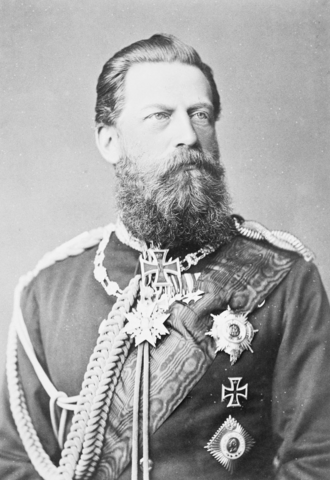 Frederick III, German Emperor1831 – 1888As King of Prussia German Emperor (1831–1888)Source: Wikidata (citizenship)
 Ernst Ruska1906 – 1988German physicist (1906–1988)Source: Wikidata (citizenship)
 Martin Niemöller1892 – 1984German theologian (1892–1984)Source: Wikidata (citizenship)
 Alfred Rosenberg1893 – 1946Baltic German architect, Nazi politician and ideologue (1893-1946)Source: Wikidata (citizenship)
 Otto Wallach1847 – 1931German chemist (1847–1931)Source: Wikidata (citizenship)
 Erich Kästner1899 – 1974German children's writer (1899–1974)Source: Wikidata (citizenship)
 Felix Klein1849 – 1925German mathematician, author of the Erlangen Program (1849-1925)Source: Wikidata (citizenship)
 Eduard Bernstein1850 – 1932German politician and theorist (1850–1932)Source: Wikidata (citizenship)
 Friedrich Wöhler1800 – 1882German chemist (1800-1882)Source: Wikidata (citizenship)
 Franz Boas1858 – 1942German-American anthropologistSource: Wikidata (citizenship)
 Friedrich Paulus1890 – 1957German general (1890–1957)Source: Wikidata (citizenship)
 Rudolf Carnap1891 – 1970German philosopher and logician (1891–1970)Source: Wikidata (citizenship)
 Richard Willstätter1872 – 1942German chemist (1872–1942)Source: Wikidata (citizenship)
 Otto Heinrich Warburg1883 – 1970German physiologist, medical doctor and Nobel laureate (1883–1970)Source: Wikidata (citizenship)
 Hans Fischer1881 – 1945German chemist (1881–1945)Source: Wikidata (citizenship)
 Ernst Thälmann1886 – 1944German communist politician, leader of Communist Party of Germany (1886–1944)Source: Wikidata (citizenship)
Showing the 48 best-known of 62 people.
Everything that happened
- 1899 – 1901Boxer RebellionNorth ChinaThe Boxer Rebellion, also known as the Boxer Uprising, Boxer Movement, Yihetuan Movement (traditional Chinese: 義和團運動; simplified Chinese: 义和团运动), or Boxer War, was an uprising in North China between 1899 and 1901, towards the end of the Qing dynasty, by the Society of Righteous and Harmonious Fists.Source: Wikidata (country)
- 1905 – 1907Maji Maji RebellionGerman East AfricaThe Maji Maji Rebellion (German: Maji-Maji-Aufstand, Swahili: Vita vya Maji Maji) was an armed rebellion of Africans against German colonial rule in German East Africa (modern-day Tanzania). The war was triggered by German colonial policies designed to force the indigenous population to grow cotton for export. The war lasted from 1905 to 1907, during which 75,000 to 300,000 died, overwhelmingly from famine.Source: Wikidata (country of the location)
- 1914Siege of TsingtaoQingdaoThe Siege of Tsingtao (German: Belagerung von Tsingtau; Japanese: 青島の戦い; simplified Chinese: 青岛战役; traditional Chinese: 青島戰役) was the attack on the German port of Qingdao (Tsingtao) from Jiaozhou Bay during World War I by Japan and the United Kingdom. The siege was waged against Imperial Germany between 27 August and 7 November 1914.Source: Wikidata (country)